
KDD WISDOM
As of 2021, KDD WISDOM has been discontinued: if you are interested in publishing a workshop paper on sentiment analysis, please consider ICDM SENTIRE. WISDOM (Workshop on Issues of Sentiment Discovery and Opinion Mining) aimed to explore how the wisdom of the crowds affects the evolution of the Web and of businesses gravitating around it. In particular, the workshop series explored two different stages of sentiment analysis: the former focusing on the identification of opinionated text over the Web, the latter focusing on the classification of such text either in terms of polarity detection or emotion recognition.
• WISDOM'20 (KDD 2020, August 24th, San Diego)
• WISDOM'19 (KDD 2019, August 5th, Anchorage)
• WISDOM'18 (KDD 2018, August 20th, London)
• WISDOM'17 (KDD 2017, August 14th, Halifax)
• WISDOM'16 (KDD 2016, August 14th, San Francisco)
• WISDOM'15 (KDD 2015, August 10th, Sydney)
• WISDOM'14 (KDD 2014, August 24th, New York)
• WISDOM'13 (KDD 2013, August 11th, Chicago)
• WISDOM'12 (KDD 2012, August 12th, Beijing)
RATIONALE
The exponential growth of the Social Web is virally infecting more and more critical business processes such as customer support and satisfaction, brand and reputation management, product design and marketing. Along with this global trend is the availability of large data and considerable improvement in computers’ modeling ability recently, particularly the advance in deep learning modeling, which provides promising approaches to better modeling social web and its semantics.
Web users already evolved from the era of social relationships, in which they began to get connected and started to share contents, to the era of social functionality, in which they started using social networks as the main platform for communication and dissemination of information. Today, web users are going through the era of social colonization, in which every experience on the Web can be social (e.g., Facebook Like button), and are getting ready for the era of social context, in which web contents will be highly targeted and personalized. The final stage of such Social Web evolution is the so called era of social commerce, in which communities will define future products and services. In such context, the research field of sentiment analysis, which has already been rapidly growing in the last decade, is destined to become more and more important for Web and business dynamics.
The international Workshop on Issues of Sentiment Discovery and Opinion Mining (WISDOM) aimed to explore how the wisdom of the crowds is affecting (and will affect) the evolution of the Web and of businesses gravitating around it. The workshop covered a wide range of related topics as illustrated below.
TOPICS
The workshop provided an international forum for both researchers and entrepreneurs working in the field of opinion mining to share information on their latest investigations in social information retrieval and their applications in academic research areas and industrial sectors. The broader context of the workshop comprehended AI, Semantic Web, information retrieval, web mining, social networking, and natural language processing. In addition to paper presentations, invited talks and panels discussed the interdisciplinary challenges of opinion mining and sentiment analysis. Topics of interest included but were not limited to:
• Sentiment, emotion, and stance classification
• Target or multi-target based sentiment and stance analysis
• Multilingual opinion mining
• Opinion search & retrieval
• Business intelligence applications
• Sarcasm detection and modeling
• Opinion aggregation
• Opinion spam detection
• Microtext normalization
• Sentiment summarization
• Concept-level sentiment analysis
• Psychological models for sentiment analysis
• Comparative opinion analysis
• Social ranking
• Social network analysis
• Time evolving sentiment analysis
• Influence, trust & privacy analysis
• Topic detection & trend discovery
• Big social data analysis
WISDOM'20 (KDD 2020, August 24th, San Diego)
PROGRAM
13:00 - 13:05 Opening remarks
13:05 - 14:00 Keynote talk: Towards Hardware-Aware Sentiment Analysis (Edoardo Ragusa, University of Genoa, Italy)
14:00 - 14:30 Determining the emotional experience evoked by films from online reviews (Osnat Mokryn, David Bodoff, Nadim Bader, Yael Albo and Joel Lanir)
14:30 - 15:00 SentiQ: A Probabilistic Logic Approach to Enhance Sentiment Analysis Tool Quality (Wissam Mammar Kouadri, Salima Benbernou, Mourad Ouziri, Themis Palpanas and Iheb Benamor)
15:00 - 15:30 Afternoon break
15:30 - 16:00 Deep Artificial Intelligence for Fantasy Football Multimodal Media Understanding (Aaron Baughman, Sai Gudimetla, Micah Forster, Gray Cannon, Daniel Bohm, Stephen Hammer, Chris Jason, and Jeff Powell)
16:00 - 16:30 Percolation-Based Topic Modeling for Tweets (Rob Churchill and Lisa Singh)
16:30 - 17:00 An Information Theory Approach to Detect Media Bias in News Websites (Victoria Aires, Juliana Freire, Fabiola Nakamura, Altigran da Silva and Eduardo Nakamura)
17:00 - 17:30 Emoji Prediction: Extensions and Benchmarking (Weicheng Ma, Ruibo Liu, Lili Wang and Soroush Vosoughi)
17:30 - 17:35 Closing remarks
SPEAKER
Edoardo Ragusa obtained the Master degree cum laude in Electronic Engineering and a PhD in Electronic Engineering (2018), both from Genoa University, Italy. He is currently a postdoctoral researcher at DITEN, University of Genoa. He coauthored more than 20 refereed papers in International Journals and Conferences and is a reviewer for several IEEE, Springer, and Elsevier journals and conferences. His research interests include machine learning in resource-constrained devices, convolutional neural networks, and sentiment analysis.
KEYNOTE. Towards Hardware-Aware Sentiment Analysis
Sentiment analysis is one of the main challenges of artificial intelligence. State-of-the-art frameworks for sentiment analysis often prove computationally demanding, as they rely on deep learning networks. Thus, one faces major issues when targeting their implementation on resource-constrained embedded devices. This becomes a major limitation when considering that pervasive electronics enables new applications and market opportunities. This talk presents an overview of existing approaches for the development of hardware-aware sentiment analysis solutions and their deployment on the edge devices. In particular, the dedicated hardware solutions and algorithms are discussed. The talk presents results about the design and the implementation of image sentiment predictors in embedded devices. In addition, the latest part of the speech details a novel inspection technique that relates embeddings and cognitive models.
ORGANIZERS
- Yongzheng Zhang, LinkedIn Corporation (USA)
- Erik Cambria, Nanyang Technological University (Singapore)
- Bing Liu, University of Illinois at Chicago (USA)
- Shen Huang, Glassdoor (USA)
WISDOM'19 (KDD 2019, August 5th, Anchorage)
PROGRAM
13:00 - 13:05 Opening remarks
13:05 - 14:00 Keynote talk: The Search for Emotions, Creativity, and Fairness in Language (Saif M. Mohammad)
14:00 - 14:30 Sentiment Augmented Attention Network for Cantonese Restaurant Review Analysis (Rong Xiang, Ying Jiao, and Qin Lu)
14:30 - 15:00 Coffee break
15:00 - 15:30 Understanding Filter Bubbles and Polarization in Social Networks (Uthsav Chitra and Christopher Musco)
15:30 - 16:00 Emotion Combination in Social Media Comments as Features for Sarcasm Detection (Fernando Henrique Calderon Alvarado, Po Chen Kuo, Yen-Hao Huang, and Yi-Shin Chen)
16:00 - 16:30 Evaluating the Combination of Word Embeddings with Mixture of Experts and Cascading gcForest In Identifying Sentiment Polarity (Mounika Marreddy, Subba Reddy Oota, Radha Agarwal and Radhika Mamidi)
16:30 - 17:00 Yoga-Veganism: Correlation Mining of Twitter Health Data (Tunazzina Islam)
17:00 - 17:05 Closing remarks
SPEAKER
Dr. Saif M. Mohammad is Senior Research Scientist at the National Research Council Canada (NRC). He received his Ph.D. in Computer Science from the University of Toronto. Before joining NRC, Saif was a Research Associate at the Institute of Advanced Computer Studies at the University of Maryland, College Park. His research interests are in Emotion and Sentiment Analysis, Computational Creativity, Psycholinguistics, Fairness in Language, and Information Visualization. Saif has served as General Chair for the Canada--UK Symposium on Ethics in AI, co-chair of SemEval (the largest platform for semantic evaluations), and co-organizer of WASSA (a sentiment analysis workshop). He has also served as the area chair for ACL, NAACL, and EMNLP in Sentiment Analysis and Fairness and Bias in NLP. His work on emotions has garnered media attention, with articles in Time, Washington Post, Slashdot, LiveScience, The Physics arXiv Blog, PC World, Popular Science, etc.
KEYNOTE. The Search for Emotions, Creativity, and Fairness in Language
Emotions are central to human experience, creativity, and behavior. They are crucial for organizing meaning and reasoning about the world we live in. They are ubiquitous and everyday, yet complex and nuanced. In this talk, I will describe our work on the search for emotions in language -- by humans (through data annotation projects) and by machines (in automatic emotion detection systems). I will outline ways in which emotions can be represented, challenges in obtaining reliable annotations, and approaches that lead to high-quality annotations. The lexicons thus created have entries for tens of thousands of terms. They provide fine-grained scores for basic emotions as well as for valence, arousal, and dominance (argued by some to be the core dimensions of meaning). They have wide-ranging applications in natural language processing, psychology, social sciences, digital humanities, and computational creativity. I will highlight some of the applications we have explored in literary analysis and automatic text-based music generation. I will also discuss new sentiment analysis tasks such as inferring fine-grained emotion intensity and stance from tweets, as well as detecting emotions evoked by art. I will conclude with work on quantifying biases in the way language is used and the impact of such biases on automatic emotion detection systems. From social media to home assistants, from privacy concerns to neuro-cognitive persuasion, never has natural language processing been more influential, more fraught with controversy, and more entrenched in everyday life. Thus as a community, we are uniquely positioned to make substantial impact by building applications that are not only compelling and creative but also facilitators of social equity and fairness.
ORGANIZERS
• Yongzheng Zhang, LinkedIn Corporation (USA)
• Erik Cambria, Nanyang Technological University (Singapore)
• Bing Liu, University of Illinois at Chicago (USA)
• Xiaodan Zhu, Queen's University (Canada)
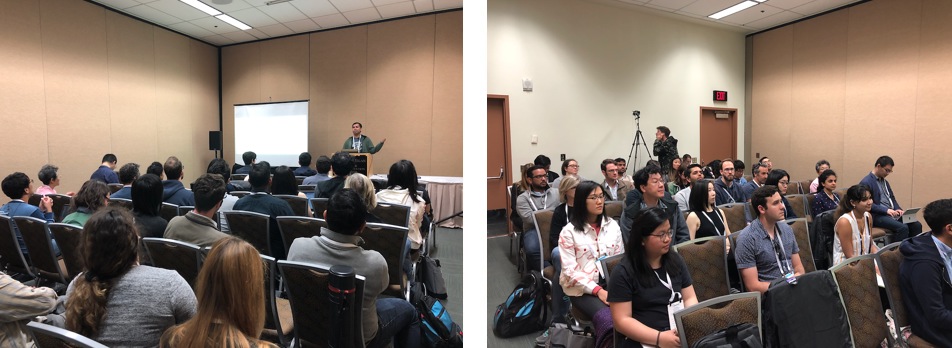
WISDOM'18 (KDD 2018, August 20th, London UK)
PROGRAM
8:00 - 8:05 Opening remarks
8:05 - 8:50 Keynote Talk I: Emotion Analysis for Detecting Signs of Mental Health Issues from Social Media (D Inkpen)
8:50 - 9:10 Market Trend Prediction using Sentiment Analysis: Lessons Learned and Paths Forward (Andrius Mudinas, Dell Zhang and Mark Levene)
9:10 - 9:30 Estimation of Inter-Sentiment Correlations Employing Deep Neural Network Models (Xinzhi Wang, Shengcheng Yuan, Hui Zhang and Yi Liu)
9:30 - 10:00: Moring break
10:05 - 10:50 Keynote Talk II: Computational Models to Emotion Analysis in Text (Y He)
10:50 - 11:10 Unsupervised Suicide Note Classification (Annika Marie Schoene and Nina Dethlefs)
11:10 - 11:30 A Fast Vote Aggregation Scheme for Sentiment Classification (Vaibhav B Sinha, Sukrut Rao and Vineeth N Balasubramanian)
11:30 - 11:50 Sentiment Analysis of Tweets by CNN Utilizing Tweets with Emoji as Training Data (Hongyi Cui, Youchao Lin and Takehito Utsuro)
11:50 - 12:00 Closing remarks
SPEAKER I
Diana Inkpen is a Professor at the University of Ottawa, in the School of Electrical Engineering and Computer Science. She obtained her Ph.D. from the University of Toronto, Department of Computer Science. She has a M.Sc. and B.Eng. degree in Computer Science and Engineering from the Technical University of Cluj-Napoca, Romania. Her research is in applications of Natural Language Processing and Text Mining. She organized seven international workshops and she was a program co-chair for the 25th Canadian Conference on Artificial Intelligence (AI 2012, Toronto, ON, May 2012) conference. She is the editor-in-chief of the Computational Intelligence journal and an associate editor for the Natural Language Engineering journal. She was an invited speaker for the Applied Natural Language Processing track at the 29th Florida Artificial Intelligence Research Society Conference (FLAIRS 2016, Key Largo, FL, May 2016), for the 28th Canadian Conference on Artificial Intelligence (AI 2015, Halifax, NS, June 2015), and International Symposium on Information Management and Big Data (SimBig 2015, Cuzco, Peru, September 2015). She published a book on Natural Language Processing for Social Media (Morgan and Claypool Publishers, Synthesis Lectures on Human Language Technologies, the second edition appeared in 2017), 9 book chapters, more than 30 journal articles and more than 100 conference papers. She received many research grants, from which the majority include intensive industrial collaborations.
KEYNOTE I. Emotion Analysis for Detecting Signs of Mental Health Issues from Social Media
Mental illness detection in social media is a complex task, mainly due to the complicated nature of mental disorders. We designed an automated system that can identify at-risk users from their public social media activity. For the first set of experiments, we collected tweets from the #BellLetsTalk campaign, which is a wide-reaching, multi-year program designed to break the silence around mental illness and support mental health across Canada. We designed user-level classifiers that can detect signs of mental illnesses (depression, negative emotions, aggressive behaviour, etc.) given limited unstructured text data extracted from various social media. We also propose a multi-task learning architecture based on deep learning, in order to take advantage of shared knowledge among tasks. We present experiments with two or more tasks, including classifiers for emotions, depression, and cyberbullying. We test on several datasets, in order to demonstrate the generality of our classifiers.
SPEAKER II
Yulan He is a Reader in Computer Science and the Director of the Systems Analytics Research Institute at Aston University, UK. She obtained her PhD degree in spoken language understanding from the University of Cambridge. Yulan is experienced in statistical modelling and text mining, particularly the integration of machine learning and natural language processing for social media analysis. She has published over 150 papers on topics including sentiment analysis, information extraction, clinical text mining, recommender systems, learning analytics and spoken dialogue systems. In the past, she has served as an Area Chair in Sentiment Analysis in top natural language processing conferences including ACL, EMNLP and NAACL.
KEYNOTE II. Computational Models to Emotion Analysis in Text
Text might contain or evoke multiple emotions with varying intensities. Traditional approaches typically cast the problem of detecting multiple emotions from text as multi-label classification. This talk will first present a novel ranking-based approach to generate a ranked list of relevant emotions where top ranked emotions are more intensely associated with text compared to lower ranked emotions. Furthermore, since emotions might be evoked by different hidden topics, it is important to unveil and incorporate such topical information to understand how the emotions are evoked. A novel neural network approach with topical information incorporated will be discussed for relevant emotion ranking. Finally, the problem of identifying the reasons behind a certain emotion expressed in text can be framed as a reading comprehension task and a new approach based on memory networks will be presented for emotion cause detection from text.
ORGANIZERS
• Yongzheng Zhang, LinkedIn Corporation (USA)
• Erik Cambria, Nanyang Technological University (Singapore)
• Bing Liu, University of Illinois at Chicago (USA)
• Xiaodan Zhu, Queen's University (Canada)
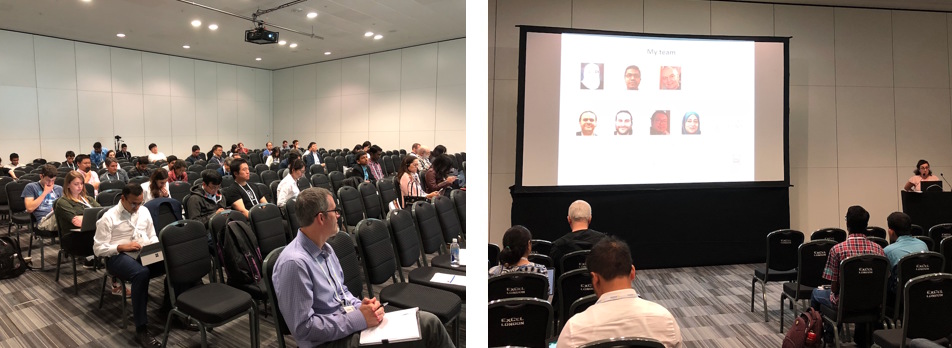
WISDOM'17 (KDD 2017, August 14th, Halifax)
PROGRAM
13:00 - 13:10 Opening remarks
13:10 - 14:10 Keynote Talk: Deep Learning for Contrasting Meaning Representation and Composition (XD Zhu)
14:10 - 14:35 Barycentric coordinates for ordinal sentiment classification (B Keith)
14:35 - 15:00 Viscovery: A platform for trend tracking in opinion forums (I Espinoza)
15:00 - 15:30: Coffee Break
15:30 - 15:55 A Hybrid Approach for Sentiment Analysis Applied to Paper Reviews (E Fuentes)
15:55 - 16:20 Unsupervised Aspect Extraction from Free-form Conversations (AE Lee)
16:20 - 16:45 Creating Domain-Specific Sentiment Lexicons via Text Mining (K Labille)
16:45 - 17:00 Closing remarks
SPEAKER
Xiaodan Zhu is an assistant professor of the Department of Electrical and Computer Engineering of Queen’s University, Canada. Before that, he was a Research Officer of the National Research Council Canada. His research interests include machine learning, natural language processing, social media analysis, and medical informatics. Xiaodan received his Ph.D. from the Department of Computer Science of the University of Toronto in 2010 and his M.Eng. from the Department of Computer Science and Technology of Tsinghua University in 2000. Xiaodan has worked with industrial research labs such as IBM T.J. Watson Research Center, Google Research, Intel Research, and Microsoft Research Asia, as a research intern, visiting scholar, or a full-time researcher.
KEYNOTE
Contrasting meaning is a basic aspect of semantics. Sentiment can be regarded as a special case of it. In this talk, we discuss our deep learning approaches to modeling two basic problems: learning representation for contrasting meaning at the lexical level and performing semantic composition to obtain representation for larger text spans, e.g., phrases and sentences. We first present our neural network models for learning distributed representation that encodes contrasting meaning among words. We discuss how the models utilize both distributional statistics and lexical resources to obtain the state-of-the-art performance on the benchmark dataset, the GRE “most contrasting word” questions. Based on lexical representation, the next basic problem is to learn representation for larger text spans through semantic composition. In the second half of the talk, we focus on deep learning models that learn composition functions by considering both compositional and non-compositional factors. The models can effectively obtain representation for phrases and sentences, and they demonstrate the state-of-the-art performance on different sentiment analysis benchmarks, including the Stanford Sentiment Treebank and the datasets used in SemEval Sentiment Analysis in Twitter.
ORGANIZERS
• Yongzheng Zhang, LinkedIn Corporation (USA)
• Erik Cambria, Nanyang Technological University (Singapore)
• Bing Liu, University of Illinois at Chicago (USA)
• Yunqing Xia, Microsoft Research Asia (China)
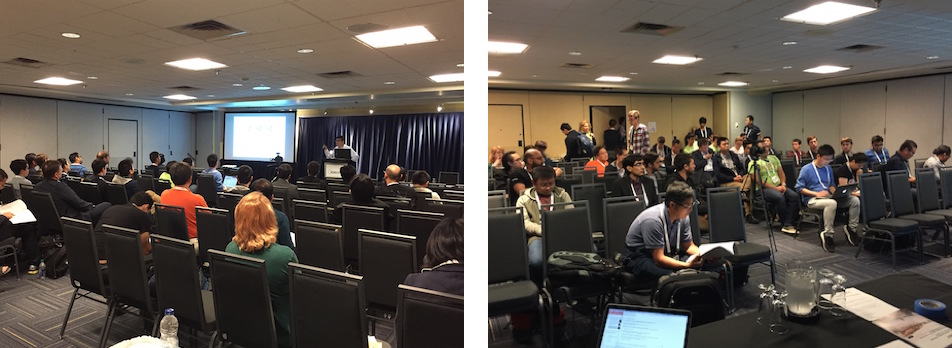
WISDOM'16 (KDD 2016, August 14th, San Francisco)
PROGRAM
8:00 - 8:10 Opening remarks
8:10 - 9:00 Keynote Talk I: Social Influence and Sentiment Analysis (J. Tang)
9:00 - 9:20 Actionable and Political Text Classification Using Word Embeddings and LSTM (A. Rao)
9:20 - 9:40 Predicting Trust Relations Among Users in a Social Network: On the Role of Influence, Cohesion and Valence (N. Vedula)
9:40 - 10:00 AnonyMine: Mining Anonymous Social Media Posts Using Psycho-lingual and Crowd-sourced Dictionaries (A. Paul)
10:00 - 10:30: Coffee Break
10:30 - 11:20 Keynote talk II: Obtaining Quality Labeled Data for Opinion Mining in Short Text (V. Markman)
11:20 - 11:40 A Framework for Emotion Recognition from Human Computer Interaction in Natural Setting (L. Constantine)
11:40 - 12:00 From Node Embedding To Community Embedding (S. Cavallari)
12:00 - 12:10 Closing remarks
SPEAKER I
Jie Tang is a tenured associate professor with the Department of Computer Science and Technology at Tsinghua University, and was also visiting scholar at Cornell University. His interests include social network analysis, data mining, and machine learning. He has published more than 200 journal/conference papers and holds 20 patents. His papers have been cited by more than 6,000 times (Google Scholar). He served as PC Co-Chair of CIKM’16, WSDM’15, ASONAM’15, SocInfo’12, KDD-CUP/Poster/Workshop/Local/Publication Co-Chair of KDD’11-15, and Associate Editor-in-Chief of ACM TKDD, Editors of IEEE TKDE/TBD and ACM TIST. He leads the project AMiner.org for academic social network analysis and mining, which has attracted more than 8 million independent IP accesses from 220 countries/regions in the world. He was honored with the Newton Advanced Scholarship Award, CCF Young Scientist Award, and NSFC Excellent Young Scholar.
KEYNOTE I. Social Influence and Sentiment Analysis
Social influence is the behavioral change of a person because of the perceived relationship with other people, organizations and society in general. Social influence has been a widely accepted phenomenon in social networks for decades. Many applications have been built based around the implicit notation of social influence between people, such as marketing, advertisement and recommendations. With the exponential growth of online social network services such as Facebook and Twitter, social influence can for the first time be measured over a large population. In this talk, I will present how we quantify the influential degree between users and also introduce the application of social influence to sentiment analysis in large social networks.
SPEAKER II
Vita Markman is a Staff Software Engineer at LinkedIn, where she works on various natural language processing applications such as sentiment analysis on customer feedback, member and job data standardization, and member-job match filtering. Before joining LinkedIn, she was a Staff Research Engineer at Samsung Research America, where among other projects, she worked on extracting topic-indicative phrases from a stream of closed caption news data in real-time and text-mining customer support chat-logs for common issues customers experience. Prior to Samsung Research, she was employed as a Computational Linguist at Disney Interactive, where she led a team of linguists and annotators to develop a proprietary patented language-filtering system for ensuring safety and appropriateness of user-generated linguistic content in Disney’s online games for kids. In addition, Vita conducts independent research on mining the language of social media. Her primary interests are focused on extracting topics and sentiment from micro-text – the short, snippet-like pieces of text found on Twitter, Facebook, and in various other social media sources. This includes discovering phrase-based sentiment features in Amazon feedback data, clustering micro-tweets by topic, and mining online product reviews to identify features people rate as positive or negative. Vita’s education background is in theoretical and computational linguistics (Rutgers, 2005). In addition to computational linguistics, she has publication record in theoretical syntax and morphology, which was her primary area of research between the years of 2002 – 2008.
KEYNOTE II. Obtaining Quality Labeled Data for Opinion Mining in Short Text
Quality training data is essential for building high performance machine learning models. However, certain types of tasks such as opinion mining are inherently subjective, making it hard to elicit reliable judgments from human annotators. The problem is further exacerbated in situations where opinions are elicited on short text such as Tweets or micro reviews containing only one or two lines. The talk addresses various means of circumventing these challenges via automation of some annotation tasks as well as setting up multiple experiments for collecting human judgments.
ORGANIZERS
• Yongzheng Zhang, LinkedIn Corporation (USA)
• Erik Cambria, Nanyang Technological University (Singapore)
• Bing Liu, University of Illinois at Chicago (USA)
• Yunqing Xia, Microsoft Research Asia (China)
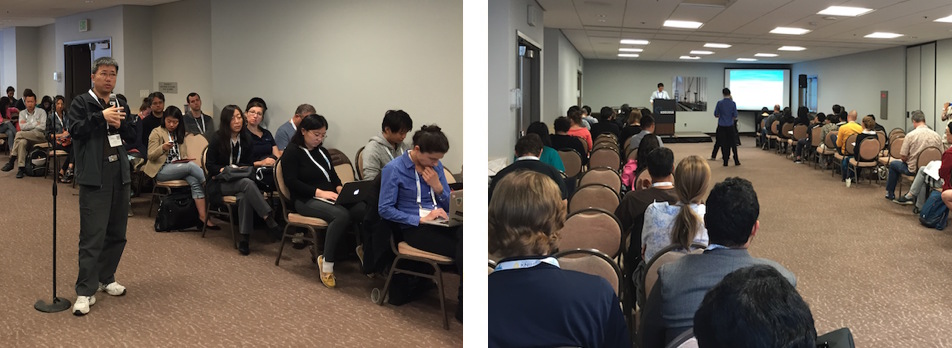
WISDOM'15 (KDD 2015, August 10th, Sydney)
PROGRAM
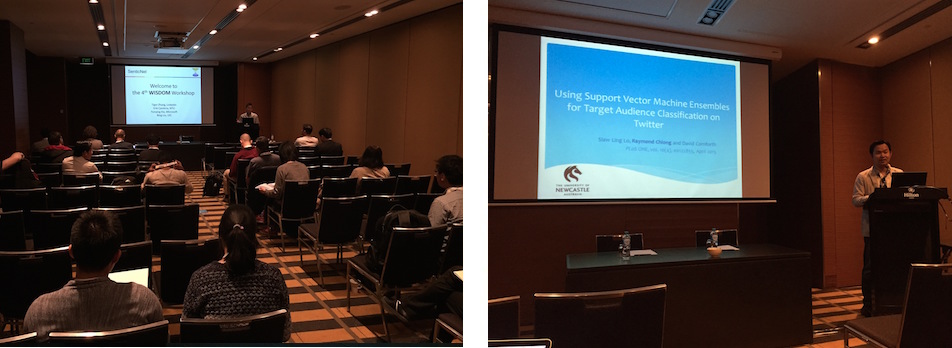
1:30-2:30: Using Support Vector Machine Ensembles for Target Audience Classification on Twitter (Raymond Chiong)
2:30-3:00: Spatial and Temporal Word Spectrum of Social Media (X. Li)
3:00-3:30: Coffee Break
3:30-4:00: SarcasmBot - An open-source sarcasm-generation module for chatbots (A. Joshi)
4:00-4:30: Multilingual Subjectivity Detection using Deep Multiple Kernel Learning (I. Chaturvedi)
4:30-5:00: Smiley Captcha and Smiley Games Solving Complex Problems (S. Aggarwal)
5:00-5:30: Customer Intentions Analysis of Twitter Based on Lexico Semantic Patterns (M. Hamroun)
5:30-6:00: Incremental Active Opinion Learning Over a Stream of Polarized Documents (M. Zimmermann)
6:00 Closing Remarks
SPEAKER
Raymond Chiong is a tenured academic staff member with the School of Design,
Communication and Information Technology at The University of Newcastle,
Australia. He is also a Guest Research Professor of the Center for Modern
Information Management at Huazhong University of Science and Technology,
China. He obtained his PhD degree from the University of Melbourne,
Australia, and his MSc degree from the University of Birmingham, England. He
has been actively pursuing research in evolutionary game theory,
optimization (focusing on production and logistics problems), data analytics
and modelling of complex adaptive systems. He was the Editor-in-Chief of the
Interdisciplinary Journal of Information, Knowledge, and Management from
2011 to 2014. Currently, he is an Editor for the journal Engineering
Applications of Artificial Intelligence and an Associate Editor for the IEEE
Computational Intelligence Magazine. He has also served as Guest Editors for
a number of reputable journals such as the International Journal of
Production Economics and European Journal of Operational Research. He is an
IEEE Senior Member, and one of the Founding co-Chairs of the IEEE Symposium
on Computational Intelligence in Production and Logistics Systems. To date,
he has produced/co-authored over 100 refereed publications in the form of
books, book chapters, journal articles and conference papers, among others.
KEYNOTE
The vast amount and diversity of data shared on social media can pose a
challenge for any business wanting to use it for identifying potential
customers. In our work, we use both unsupervised and supervised learning
methods to classify the target audience of a Twitter account owner with
minimal annotation efforts. We first identify topic domains automatically
using data shared by followers of the account owner using Twitter Latent
Dirichlet Allocation (LDA). We then train a Support Vector Machine (SVM)
ensemble using data from different account owners of the various topic
domains identified by Twitter LDA. Experimental results show that our
methods are able to successfully identify the target audience with high
accuracy. In addition, we show that using a statistical inference approach
such as bootstrapping in over-sampling to construct training datasets can
achieve a better classifier in the SVM ensemble. This ensemble system can
take advantage of data diversity, and its ability to differentiate
prospective customers from the general audience may lead to the development
of an application for targeted marketing, leading to business advantage in
the crowded social media space.
ORGANIZERS
• Yongzheng Zhang, LinkedIn Corporation (USA)
• Erik Cambria, Nanyang Technological University (Singapore)
• Yunqing Xia, Microsoft Research Asia (China)
• Bing Liu, University of Illinois at Chicago (USA)
WISDOM'14 (KDD 2014, August 24th, New York)
PROGRAM
09:15-10:20: KEYNOTE
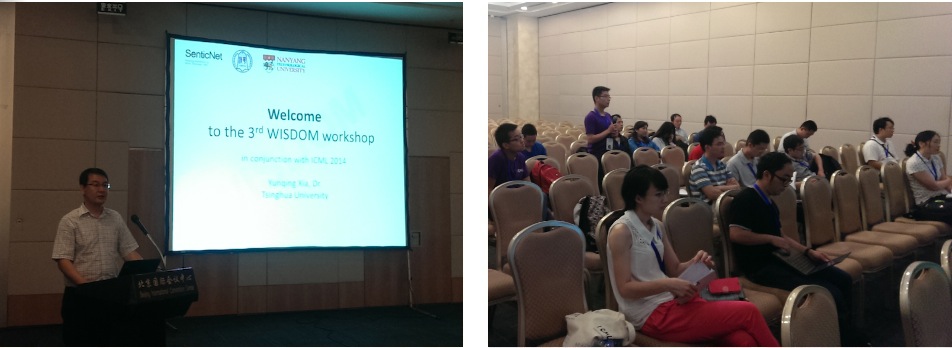
• Opening Remarks (Yunqing Xia)
• Instance-based domain adaptation (Rui Xia)
10:20-10:40: Coffee Break
10:40-12:00: SESSION I
• Multi-granularity comparison on Chinese and English reviews: A case study in IT product domain (Qingqing Zhou)
• WEMOTE - Word embedding based minority oversampling technique for imbalanced emotion and sentiment classification (Chen Tao)
• Disambiguating word sentiment polarity through Bayesian modeling and opinion-level features (Yunqing Xia)
12:00-14:00: Lunch Break
14:00-15:20: SESSION II
• Cross-lingual Twitter polarity detection via projection across word-aligned corpora (Mohamed Abdel-Hady)
• Sentiment analysis in Turkish social media (Cumali Türkmenoğlu)
• A two-Level learning hierarchy of nonnegative matrix factorization based topic modeling for main topic extraction (Hendri Murfi)
• Closing Remarks (Yunqing Xia)
SPEAKER
Rui Xia is currently an assistant professor at School of Computer
Science and Engineering, Nanjing University of Science and Technology,
China. His research interests include machine learning, natural
language processing, text mining and sentiment analysis. He received
the Ph.D. degree from the Institute of Automation, Chinese Academy of
Sciences in 2011. He has published several refereed conference papers
in the areas of artificial intelligence and natural language
processing, including IJCAI, AAAI, ACL, COLING, etc. He served on the
program committee member of several international conferences and
workshops including IJCAI, COLING, WWW Workshop on MABSDA, KDD
Workshop on WISDOM and ICDM Workshop on SENTIRE. He is a member of
ACM, ACL and CCF, and he is an operating committee member of YSSNLP.
KEYNOTE
On one hand, most of the existing domain adaptation studies in the
field of NLP belong to the feature-based adaptation, while the
research of instance-based adaptation is very scarce. One the other
hand, due to the explosive growth of the Internet online reviews, we
can easily collect a large amount of labeled reviews from different
domains. But only some of them are beneficial for training a desired
target-domain sentiment classifier. Therefore, it is important for us
to identify those samples that are the most relevant to the target
domain and use them as training data.
To address this problem, we propose two instance-based domain
adaptation methods for NLP applications. The first one is called PUIS
and PUIW, which conduct instance adaptation based on instance
selection and instance weighting via PU learning. The second one is
called in-target-domain logistic approximation (ILA), where we conduct
instance adaptation by a joint logistic approximation model. Both of
methods achieve sound performance in high-dimensional NLP tasks such
as cross-domain text categorization and sentiment classification.
ORGANIZERS
• Yunqing Xia, Tsinghua University (China)
• Erik Cambria, Nanyang Technological University (Singapore)
• Yongzheng Zhang, LinkedIn Corporation (USA)
• Newton Howard, MIT Media Laboratory (USA)
WISDOM'13 (KDD 2013, August 11th, Chicago)
PROGRAM
09:00-10:10: KEYNOTE
• Opening Remarks
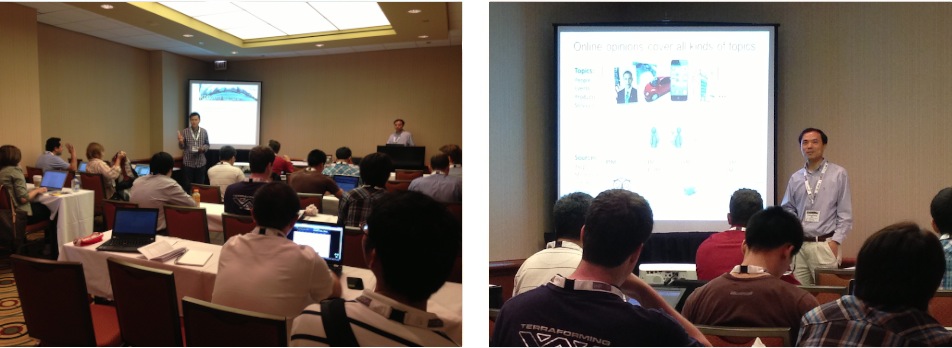
• Statistical Methods for Integration and Analysis of Opinionated Text Data (Chengxiang Zhai)
10:10-10:30: Coffee Break
10:30-12:00: SESSION I
• Identifying Purpose Behind Electoral Tweets (Saif Mohammad, Svetlana Kiritchenko, and Joel Martin)
• Combining Strengths, Emotions and Polarities for Boosting Twitter Sentiment Analysis (Felipe Bravo-Marquez, Marcelo Mendoza, and Barbara Poblete)
• Modelling Political Disaffection from Twitter Data (Corrado Monti, Alessandro Rozza, Giovanni Zappella, Matteo Zignani, Adam Arvidsson, and Elanor Colleoni)
12:00-13:30: Lunch Break
13:30-15:30: SESSION II
• Enhancing Sentiment Extraction from Text by Means of Arguments (Lucas Carstens and Francesca Toni)
• Evaluation of an Algorithm for Aspect-Based Opinion Mining Using a Lexicon-Based Approach (Florian Wogenstein, Johannes Drescher, Dirk Reinel, Sven Rill, and Jörg Scheidt)
• Commonsense-Based Topic Modeling (Dheeraj Rajagopal, Daniel Olsher, Erik Cambria, and Kenneth Kwok)
• Online Debate Summarization using Topic Directed Sentiment Analysis (Sarvesh Ranade, Jayant Gupta, Vasudeva Varma, and Radhika Mamidi)
15:30-16:00: Coffee Break
16:00-17:00: SESSION III
• RBEM: A Rule Based Approach to Polarity Detection (Erik Tromp and Mykola Pechenizkiy)
• Cross-lingual Polarity Detection with Machine Translation (Erkin Demirtas and Mykola Pechenizkiy)
• Sentribute: Image Sentiment Analysis from a Mid-level Perspective (Jianbo Yuan, Quanzeng You, Sean Mcdonough, and Jiebo Luo)
• Closing Remarks
SPEAKER
ChengXiang Zhai is an Associate Professor of Computer Science at the University of Illinois at Urbana-Champaign, where he is also affiliated
with the Graduate School of Library and Information Science, Institute for Genomic Biology, and Department of Statistics. He received a Ph.D. in Computer Science from Nanjing University in 1990, and a Ph.D. in Language and Information Technologies from Carnegie Mellon University in 2002. He worked at Clairvoyance Corp. as a Research Scientist and a Senior Research Scientist from 1997 to 2000. His research interests include information retrieval, text mining, natural language processing, machine learning, and biomedical informatics, in which he published over 150 research papers. He is an Associate Editor of ACM Transactions on Information Systems, and Information Processing and Management, and serves on the editorial board of Information Retrieval Journal. He is a program co-chair of ACM CIKM 2004, NAACL HLT 2007, and ACM SIGIR 2009. He is an ACM Distinguished Scientist and a recipient of multiple best paper awards, Alfred P. Sloan Research Fellowship, IBM Faculty Award, HP Innovation Research Program Award, and the Presidential Early Career Award for Scientists and Engineers (PECASE).
KEYNOTE
Opinionated text data such as blogs, forum posts, product reviews and online comments are increasingly available on the Web. They are very useful sources for public opinions about virtually any topics. However, because the opinions are scattered and abundant, it is a significant challenge for users to collect all the opinions about a topic and digest them efficiently. In this talk, I will present a suite of general statistical text mining methods that can help users integrate, summarize and analyze scattered online opinions to obtain actionable knowledge for decision making. Specifically, I will first present approaches to integration of scattered opinions by aligning them to a well-structured article or relevant ontology. Second, I will discuss several techniques for generating a concise opinion summary that can reveal the major sentiments and opinion points buried in large amounts of opinionated text data. Finally, I will present probabilistic general models for analyzing review data in depth to discover latent aspect ratings and relative weights placed by reviewers on different aspects. These methods are completely general and can thus help users integrate and analyze large amounts of online opinionated text data on any topic in any natural language.
ORGANIZERS
• Erik Cambria, National University of Singapore (Singapore)
• Bing Liu, University of Illinois at Chicago (USA)
• Yongzheng Zhang, eBay Corporation (USA)
• Yunqing Xia, Tsinghua University (China)
WISDOM'12 (KDD 2012, August 12th, Beijing)
PROGRAM
09:00-10:15: KEYNOTE
• Opening Remarks
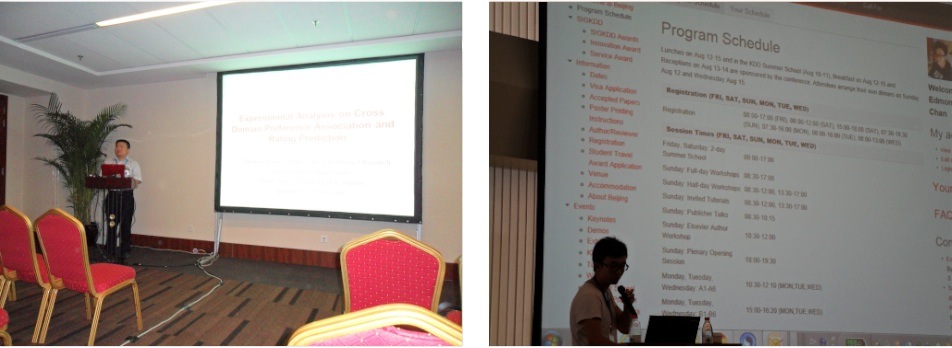
• Detecting Fake Opinions in Social Media (Bing Liu)
10:15-10:30: Coffee Break
10:30-12:00: SESSION I
• A Bayesian Modeling Approach to Multi-Dimensional Sentiment Distributions Prediction (Yulan He)
• Transverse Subjectivity Classification (Dinko Lambov and Gaël Dias)
• Combining Lexicon and Learning based Approaches for Concept-Level Sentiment Analysis (Andrius Mudinas, Dell Zhang, and Mark Levene)
12:00-13:30: Lunch Break
13:30-15:15: SESSION II
• A Unified Graph Model for Chinese Product Review Summarization Using Richer Information (He Huang and Chunping Li)
• Retrieval Approach to Extract Opinions about People from Resource Scarce Language News Articles (Aditya Mogadala and Vasudeva Varma)
• A Generic Approach to Generate Opinion Lists of Phrases for Opinion Mining Applications (Sven Rill, Johannes Drescher, Dirk Reinel, Joerg Scheidt, Oliver Schuetz, Florian Wogenstein, and Daniel Simon)
• Finding Emotion in Image Descriptions (Morgan Ulinski, Victor Soto, and Julia Hirschberg)
15:15-15:30: Coffee Break
15:30-17:00: SESSION III
• Predicting Collective Sentiment Dynamics from Time-series Social Media (Le Nguyen, Pang Wu, William Chan, Wei Peng, and Ying Zhang)
• Crowdsourcing Recommendations from Social Sentiment (Yusheng Xie, Yu Cheng, Daniel Honbo, Kunpeng Zhang, Ankit Agrawal, and Alok Choudhary)
• Fast Learning for Sentiment Analysis on Bullying (Jun-Ming Xu, Xiaojin Zhu, and Amy Bellmore)
• Closing Remarks
SPEAKER
Bing Liu is a professor of Computer Science at University of Illinois at Chicago (UIC). He received his PhD in Artificial Intelligence from the University of Edinburgh. Before joining UIC, he was with the National University of Singapore. His current research interests include opinion mining and sentiment analysis, Web mining, and data mining. He has published extensively in leading conferences and journals in these fields. He has also written a textbook titled “Web Data Mining: Exploring Hyperlinks, Contents and Usage Data” published by Springer. The second edition of the book came out in July 2011. On professional services, Liu has served as program chairs of ACM SIGKDD International Conference on Knowledge Discovery and Data Mining (KDD), IEEE International Conference on Data Mining (ICDM), ACM Conference on Web Search and Data Mining (WSDM), SIAM Conference on Data Mining (SDM), ACM Conference on Information and Knowledge Management (CIKM), and Pacific Asia Conference on Data Mining (PAKDD). Additionally, he has also served as associate editors of IEEE Transactions on Knowledge and Data Engineering (TKDE), Journal of Data Mining and Knowledge Discovery (DMKD), and SIGKDD Explorations, and is on the editorial boards of several other journals.
KEYNOTE
Opinions from social media are increasingly used by individuals and organizations for making purchase decisions and making choices at elections and for marketing and product design. Positive opinions often mean profits and fames for businesses and individuals, which, unfortunately, give strong incentives for people to game the system by posting fake opinions or reviews to promote or to discredit some target products, services, organizations, individuals, and even ideas without disclosing their true intentions, or the person or organization that they are secretly working for. Such individuals are called opinion spammers and their activities are called opinion spamming. Opinion spamming about social and political issues can even be frightening as they can warp opinions and mobilize masses into positions counter to legal or ethical mores. It is safe to say that as opinions in social media are increasingly used in practice, opinion spamming will become more and more rampant and sophisticated, which presents a major challenge for their detection. However, they must be detected in order to ensure that the social media is a trusted source of public opinions, rather than is full of fake opinions, lies, and deceptions. In this talk, I will introduce this research topic and discuss some state-of-the-art opinion spam detection techniques.
ORGANIZERS
• Erik Cambria, National University of Singapore (Singapore)
• Yongzheng Zhang, eBay Corporation (USA)
• Yunqing Xia, Tsinghua University (China)
• Newton Howard, MIT Media Laboratory (USA)
follow SenticNet on


