
ICDM SENTIRE
Sentiment Elicitation from Natural Text for Information Retrieval and Extraction (SENTIRE) is the IEEE ICDM workshop series on opinion mining since 2011. The term sentire (pronounced /senˈti.re/) comes from the Latin feel and it is root of words such as sentiment and sensation. SENTIRE aims to provide an international forum for researchers in the field of opinion mining and sentiment analysis to share information on their latest investigations in social information retrieval and their applications both in academic research areas and industrial sectors. The broader context of the workshop comprehends Web mining, AI, Semantic Web, information retrieval and natural language processing. SENTIRE proceedings are published within IEEE ICDMW proceedings and, hence, are both Scopus- and SCI-indexed. Some videos of past SENTIRE editions are available on SenticNet YouTube Channel. For more info, write to workshop_name@sentic.net
• SENTIRE'23 (ICDM 2023, December 1st, Shanghai)
• SENTIRE'22 (ICDM 2022, November 28th, Orlando)
• SENTIRE'21 (ICDM 2021, December 7th, Auckland)
• SENTIRE'20 (ICDM 2020, November 17th, Sorrento)
• SENTIRE'19 (ICDM 2019, November 8th, Beijing)
• SENTIRE'18 (ICDM 2018, November 17th, Singapore)
• SENTIRE'17 (ICDM 2017, November 18th, New Orleans)
• SENTIRE'16 (ICDM 2016, December 12th, Barcelona)
• SENTIRE'15 (ICDM 2015, November 14th, Atlantic City)
• SENTIRE'14 (ICDM 2014, December 14th, Shenzhen)
• SENTIRE'13 (ICDM 2013, December 7th, Dallas)
• SENTIRE'12 (ICDM 2012, December 10th, Brussels)
• SENTIRE'11 (ICDM 2011, December 11th, Vancouver)
RATIONALE
Memory and data capacities double approximately every two years and, apparently, the Web is following the same rule. User-generated contents, in particular, are an ever-growing source of opinion and sentiments which are continuously spread worldwide through blogs, wikis, fora, chats and social networks. The distillation of knowledge from such sources is a key factor for applications in fields such as commerce, tourism, education and health, but the quantity and the nature of the contents they generate make it a very difficult task. Due to such challenging research problems and wide variety of practical applications, opinion mining and sentiment analysis have become very active research areas in the last decade.
Our understanding and knowledge of the problem and its solution are still limited as natural language understanding techniques are still pretty weak. Most of current research in sentiment analysis, in fact, merely relies on machine learning algorithms. Such algorithms, despite most of them being very effective, produce no human understandable results such that we know little about how and why output values are obtained. All such approaches, moreover, rely on syntactical structure of text, which is far from the way the human mind processes natural language. Next-generation opinion mining systems should employ techniques capable to better grasp the conceptual rules that govern sentiment and the clues that can convey these concepts from realization to verbalization in the human mind.
TOPICS
SENTIRE aims to provide an international forum for researchers in the field of opinion mining and sentiment analysis to share information on their latest investigations in social information retrieval and their applications both in academic research areas and industrial sectors. The broader context of the workshop comprehends Web mining, AI, Semantic Web, information retrieval and natural language processing. Topics of interest include but are not limited to:
• Sentiment identification and classification
• Opinion and sentiment summarization and visualization
• Aspect extraction
• Linguistic patterns for sentiment analysis
• Learning word dependencies in text
• Statistical learning theory for big social data analysis
• Sarcasm detection
• Microtext normalization
• Sentic computing
• Large commonsense graphs
• Conceptual primitives for sentiment analysis
• Multimodal emotion recognition and sentiment analysis
• Time evolving opinion and sentiment analysis
• Semantic multidimensional scaling for sentiment analysis
• Multidomain and cross-domain evaluation
• Domain adaptation for sentiment classification
• Affective knowledge acquisition for sentiment analysis
• Sentiment topic detection and trend discovery
• Social network analysis
• Social media marketing
• Opinion spam detection
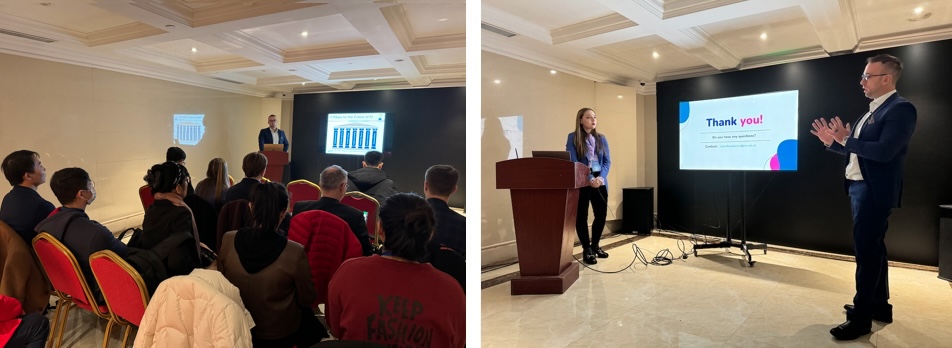
SENTIRE'23 (ICDM 2023, December 1st, Shanghai)
SENTIRE is taking place in Room 10. Each talk is allocated 15 mins (10-min presentation + 5-min Q&A session). However, please note that the program is just indicative: if a presenter is missing, we'll go ahead with the next talk. All times are in Western Standard Time (GMT+8).
PROGRAM
09:00-09:05 Welcoming and introduction (E Cambria)
09:05-09:30 Knowledge Representation for Conceptual, Motivational and Affective Processes (SB Ho)
09:30-09:45 From Big to Small Without Losing it All: ChatGPT for Sentiment Analysis (S Woźniak)
09:45-10:00 From Generalized Laughter to Personalized Chuckles (J Bielaniewicz)
☕ COFFEE BREAK
10:30-10:45 Modeling Uncertainty in Personalized Emotion Prediction (P Miłkowski)
10:45-11:00 Emotion Recognition in Social Network Text Based on a Multilingual Architecture (J Zou)
11:00-11:15 A Novel Approach for Sentiment Propagation in Multilingual WordNets (J Kocoń)
11:15-11:30 Towards Model-Based Data Acquisition for Subjective Multitask NLP (K Kanclerz)
11:30-11:45 Aspect-Based Sentiment Analysis Incorporating External Knowledge (A Teo)
11:45-12:00 Video Sentiment Analysis for Child Safety (Y Tan)
🍝 LUNCH BREAK
13:00-13:15 BLM-17m: A Large-Scale Dataset for Black Lives Matter on Twitter (Y Li)
13:15-13:30 Non-Fungible Tokens: What Makes Them Valuable? (Z Leitter)
13:30-13:45 FinXABSA: Explainable Finance through Aspect-Based Sentiment Analysis (K Ong)
13:45-13:55 Sentiment Analysis of Primary Historical Sources (A Nanetti)
13:55-14:00 Concluding remarks (E Cambria)
SPEAKER
Dr Seng-Beng Ho is currently a Senior Scientist at the Institute of High Performance Computing (IHPC), A*STAR, Singapore, conducting research on AI. He obtained his Ph.D. in Cognitive Science (AI, Neuroscience, Psychology, and Linguistics) and M.Sc. in Computer Science from the University of Wisconsin, Madison, U.S.A. He has a B.E. in Electronic Engineering from the University of Western Australia. He has published a number of AI-related papers in international journals and conferences over the years and he is the author of a monograph published in June 2016 by Springer International entitled “Principles of Noology: Toward a Theory and Science of Intelligence”. In the book, he presents a principled and fundamental theoretical framework that is critical for building truly general AI systems. For 11 years, he was President of E-Book Systems Pte Ltd, a company he founded that developed and marketed a novel 3D page-flipping interface for electronic books, with offices in the Silicon Valley, Beijing, Tokyo, Germany, and Singapore. He holds 36 U.S. and world-wide patents related to e-book technology. He has also lectured at the National University of Singapore on AI and Cognitive Science
KEYNOTE
Natural language communication is an intricate and complex process. The speaker usually begins with an intention and motivation of what is to be communicated, and what effects are expected from the communication, while taking into consideration the listener’s mental model to concoct an appropriate sentence. The listener likewise has to interpret what the speaker means, and respond accordingly, also with the speaker’s mental state in mind. To do this successfully, conceptual, motivational, and affective processes have to be represented appropriately to drive the language generation and understanding processes. Language processing has succeeded well with the big data approach in applications such as chatbots and machine translation. However, in human-robot collaborative social communication and in using natural language for delivering precise instructions to robots, a deeper representation of the conceptual, motivational, and affective processes is needed. We capitalize on the UGALRS (Unified General Autonomous and Language Reasoning System) framework and the CD+ (Conceptual Dependency Plus) representational scheme to illustrate how social communication through language is supported by a knowledge representational scheme that handles conceptual, motivational, and affective processes in a deep and general way. Though a small set of concepts, motivations, and emotions is treated in this work, its main contribution is in articulating a general framework of knowledge representation and processing to link these aspects together in serving the purpose of natural language communication for an intelligent system.
ORGANIZERS
• Erik Cambria & Rui Mao, Nanyang Technological University (Singapore)
• Zhaoxia Wang, Singapore Management University (Singapore)
• Yang Li, Northwestern Polytechnical University (China)
• Newton Howard, University of Oxford (UK)
• Bing Liu, University of Illinois at Chicago (USA)
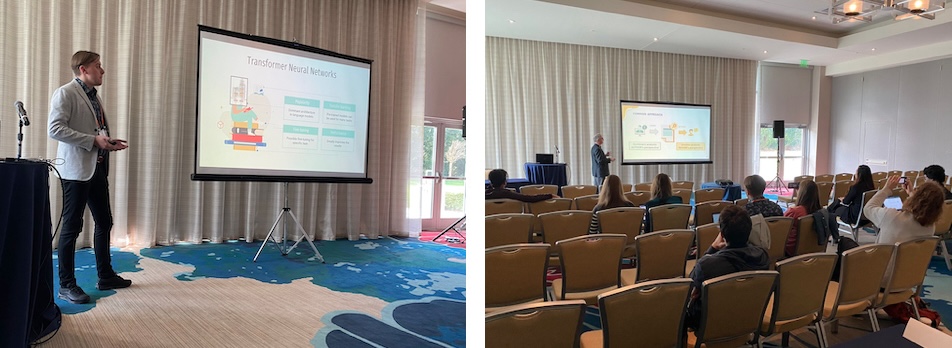
SENTIRE'22 (ICDM 2022, November 28th, Orlando)
Each talk is allocated 25 mins (20-min presentation + 5-min Q&A session). However, please note that the program is just indicative: if a presenter is missing, we'll go ahead with the next talk. Times are in Eastern Daylight Time (GMT-4).
PROGRAM
13:00-13:05 Welcoming and introduction (E Cambria)
13:05-13:45 Keynote: Is Content Alone Enough? Human-Centred Approach to Affective NLP (P Kazienko)
13:45-14:10 Compression Methods for Transformers in Multidomain Sentiment Analysis (K Kanclerz)
14:10-14:35 Making Sense of Sentiments for Aesthetic Plastic Surgery (A Choudhary)
14:35-15:00 MultiAspectEmo: Multilingual and Language-Agnostic Aspect-Based Sentiment Analysis (J Szołomicka)
☕ COFFEE BREAK
15:30-15:55 Feature Extraction and Prediction of Combined Text and Survey Data using Two-Staged Modeling (A Neloy)
15:55-16:20 Linguistic Knowledge Application to Neuro-Symbolic Transformers in Sentiment Analysis (J Baran)
16:20-16:45 Sentic Parser: A Graph-Based Approach to Concept Extraction for Sentiment Analysis (R Mao)
16:45-17:10 Stress Identification in Online Social Networks (A Kumar)
17:10-17:15 Concluding remarks (E Cambria)
SPEAKER
Przemyslaw Kazienko, Ph.D. is a full professor and leader of ENGINE - the European Centre for Data Science at Wroclaw University of Science and Technology, Poland. He authored 300+ research papers, incl. 50+ in journals with IF related to personalization and subjective tasks in NLP, affective computing and emotion recognition, social/complex network analysis, spread of influence, collective classification, machine learning, sentiment analysis, DSS in medicine, finances and telecommunication, knowledge management, collaborative systems, data mining, recommender systems, information retrieval, and data security. He led 50+ research projects, including large European ones, chiefly in cooperation with companies with total budget over €10M. He gave 20+ keynote/invited talks for international audience and served as a co-chair of over 20 international scientific conferences and workshops. He is an IEEE Senior Member, a member of the Editorial Board of several journals. He is also on the board of Network Science Society.
KEYNOTE
Most tasks in affective NLP are strongly subjective by nature. Each human may perceive textual content in their own individual way. The existing reasoning methods commonly rely on agreed output values, the same for all recipients. We propose fundamentally different – personalized solutions applicable to any subjective NLP problem. They take into account not only the text, but also opinions and beliefs of a given person. Appropriate models and experimental results on emotional data will be presented. They revealed that personalization has a greater impact on reasoning quality than commonly explored language models. Besides, we discovered a high correlation between human bias calculated using our dedicated formula and that learned by the model. Additionally, multi-task solutions gathering various emotional problems achieved better outcomes than single-task architectures.
ORGANIZERS
• Erik Cambria, Nanyang Technological University (Singapore)
• Yang Li, Northwestern Polytechnical University (China)
• Newton Howard, University of Oxford (UK)
• Bing Liu, University of Illinois at Chicago (USA)
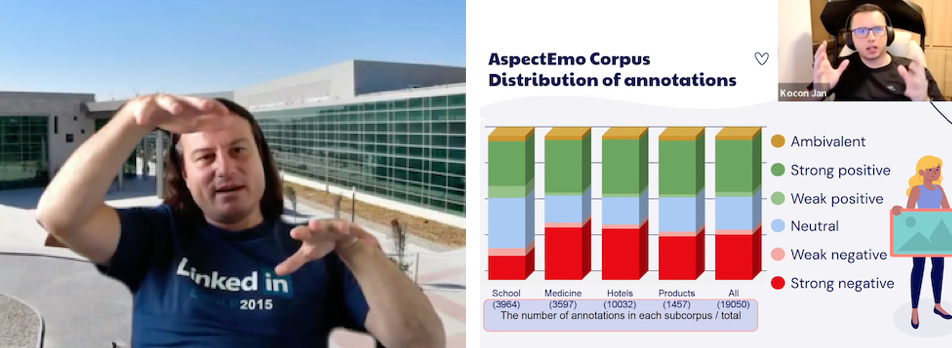
SENTIRE'21 (ICDM 2021, December 7th, Auckland)
Each talk is allocated 15 mins (10-min presentation + 5-min Q&A session). However, please note that the program is just indicative: if a presenter is missing, we'll go ahead with the next talk. Times are in New Zealand Daylight Time (GMT+13).
PROGRAM
14:00-14:15 Welcoming and introduction (E Cambria)
14:15-15:00 Detecting the "Fake News" Before It Was Even Written (P Nakov)
15:00-15:15 Modelling Context with Graph Convolutional Networks for ABSA (M Zhang)
15:15-15:30 AspectEmo: Multi-Domain Corpus of Consumer Reviews for ABSA (J Kocon)
15:30-15:45 Contexualized Embedding for Social Media-specific Sentiment Analysis (H Sakhrani)
15:45-16:00 A real-time platform for contextualized conspiracy theory analysis (D Chong)
16:15-16:30 Sentiment Analysis Using POS Features and Game-Theoretic Rough Sets (Y Chen)
16:30-16:45 Interpretable Representation for Personality Detection (A Kazemeini)
☕ COFFEE BREAK
17:15-17:30 Deep Neural Language-agnostic Multi-task Text Classifier (K Gawron)
17:30-17:45 Automated Pipeline for Sentiment Analysis of Political Tweets (A Das)
17:45-18:00 Sentiment Analysis Framework Using Data Driven Approach (MJ Islam)
18:00-18:15 A Multitask Learning Framework for Multimodal Sentiment Analysis (D Jiang)
18:15-18:30 DUSE: A New Benchmark Dataset for Drug User Sentiment Extraction (A Kumar)
18:30-18:45 Enhancing Negation Scope Detection using Multitask Learning (H Patel)
18:45-19:00 Concluding remarks (E Cambria)
SPEAKER
Dr. Preslav Nakov is a Principal Scientist at the Qatar Computing Research Institute (QCRI), HBKU, where he leads the Tanbih mega-project (developed in collaboration with MIT), which aims to limit the effect of "fake news", propaganda and media bias by making users aware of what they are reading, thus promoting media literacy and critical thinking. He received his PhD degree in Computer Science from the University of California at Berkeley, supported by a Fulbright grant. Dr. Preslav Nakov is President of ACL SIGLEX, Secretary of ACL SIGSLAV, and a member of the EACL advisory board. He is also member of the editorial board of a number of journals including Computational Linguistics, TACL, IEEE TASL, CS&L, NLE, AI Communications, and Frontiers in AI. He authored a Morgan & Claypool book on Semantic Relations between Nominals and two books on computer algorithms. He published 250+ research papers, and he was named among the top 2% of the world's most-cited in the career achievement category, part of a global list compiled by Stanford University. He received a Best Long Paper Award at CIKM'2020, a Best Demo Paper Award (Honorable Mention) at ACL'2020, a Best Task Paper Award (Honorable Mention) at SemEval'2020, a Best Poster Award at SocInfo'2019, and the Young Researcher Award at RANLP’2011. He was also the first to receive the Bulgarian President's John Atanasoff award, named after the inventor of the first automatic electronic digital computer. Dr. Nakov's research was featured by over 100 news outlets, including Forbes, Boston Globe, Aljazeera, DefenseOne, Business Insider, MIT Technology Review, Science Daily, Popular Science, Fast Company, The Register, WIRED, and Engadget, among others.
KEYNOTE
Given the recent proliferation of disinformation online, there has been growing research interest in automatically debunking rumors, false claims, and "fake news". A number of fact-checking initiatives have been launched so far, both manual and automatic, but the whole enterprise remains in a state of crisis: by the time a claim is finally fact-checked, it could have reached millions of users, and the harm caused could hardly be undone. An arguably more promising direction is to focus on analyzing entire news outlets, which can be done in advance; then, we could fact-check the news before it was even written: by checking how trustworthy the outlet that has published it is (which is what journalists actually do).
Another important observation is that the term "fake news" misleads people to focus exclusively on factuality, and to ignore the other half of the problem: the potential malicious intent. Thus, we detect the use of specific propaganda techniques in text, e.g., appeal to emotions, fear, prejudices, logical fallacies, etc.
ORGANIZERS
• Erik Cambria, Nanyang Technological University (Singapore)
• Yang Li, Northwestern Polytechnical University (China)
• Yongzheng Zhang, LinkedIn Inc. (USA)
• Bing Liu, University of Illinois at Chicago (USA)
SENTIRE'20 (ICDM 2020, November 17th, Sorrento)
PROGRAM (times are in UTC timezone)
13:00-13:10 Welcoming and introduction (E Cambria)
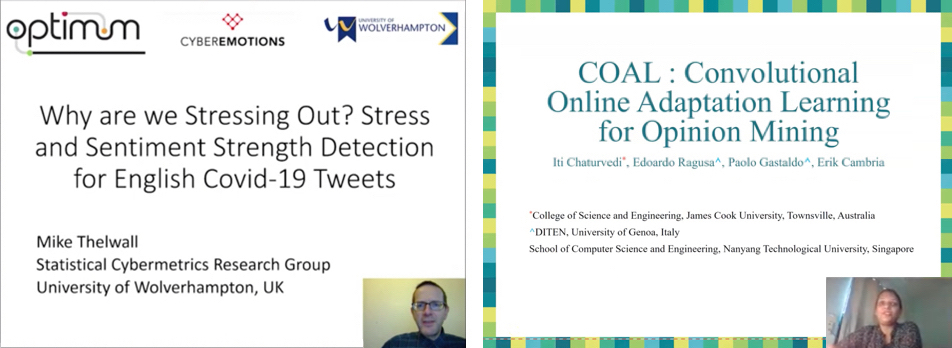
13:10-14:10 Why are we Stressing Out? Stress and Sentiment Strength Detection for English Covid-19 Tweets (M Thelwall)
14:10-14:20 Helping users discover perspectives: Enhancing opinion mining with joint topic models (T Draws)
14:20-14:30 COAL: Convolutional Online Adaptation Learning for Opinion Mining (I Chaturvedi)
14:30-14:40 WhoSNext: Recommending Twitter Users to Follow Using a Spreading Activation Network Based Approach (M Siino)
14:40-14:50 Understanding the Personality of Contributors to Information Cascades in Social Media in response to COVID-19 Pandemic (D Nurbakova)
☕ COFFEE BREAK
15:00-15:10 Sentiment is an Attitude not a Feeling (N Alsadhan)
15:10-15:20 One Belt, One Road, One Sentiment? A Hybrid Approach to Mining Opinions about the New Silk Road Initiative (J Chandra)
15:20-15:30 Integration of Fuzzy and Deep learning in Three-Way Decisions for Binary Opinion Classification (L Subhashini)
15:30-15:40 MEET: A Method for Embeddings Evaluation for Taxonomic Data (D Nobani)
15:40-15:50 Application of NLP to determine the state of issues in Bug Tracking Systems (M Pohl)
15:50-16:00 Textual Lyrics Based Emotion Analysis of Bengali Songs (S Phani)
16:00-16:10 Concluding remarks (E Cambria)
SPEAKER
Mike Thelwall is Professor of Data Science and leader of the Statistical Cybermetrics Research Group at the University of Wolverhampton, which he joined in 1989. He is also Docent at the Department of Information Studies at Åbo Akademi University, and a Professor at the University of Malaya. His PhD was in Pure Mathematics from the University of Lancaster. His current research field includes identifying and analysing web phenomena using quantitative-led research methods, including altmetrics and sentiment analysis, and has pioneered an information science approach to link analysis. Mike has developed a wide range of tools for gathering and analysing web data, including hyperlink analysis, sentiment analysis and content analysis for Twitter, YouTube, MySpace, blogs and the web in general. His 400+ publications include 355 refereed journal articles and three books, including Introduction to Webometrics. He is an associate editor of the Journal of the Association for Information Science and Technology and sits on four other editorial boards.
KEYNOTE
This talk will describe the strengths and weaknesses of the lexical stress strength and sentiment strength detection programs TensiStrength and SentiStrength and apply them to a corpus of ten million English Covid-19 tweets from March to September 2020. Lexical programs have the advantage of transparency at the cost of accuracy compared to machine learning approaches. Stress is closely related to negative sentiment and so comparing the two similar algorithms on a large collection of texts may reveal practical differences. They were therefore both applied to the Covid-19 tweets to extract lists of terms associated with negative sentiment or stress, comparing the lists to identify the types of differences produced.
ORGANIZERS
• Erik Cambria, Nanyang Technological University (Singapore)
• Rui Xia, Nanjing University of Science and Technology (China)
• Yongzheng Zhang, LinkedIn Inc. (USA)
• Bing Liu, University of Illinois at Chicago (USA)
SENTIRE'19 (ICDM 2019, November 17th, Beijing)
PROGRAM
13:30-13:40 Welcoming and introduction (E Cambria)
13:40-14:40 Keynote on Emotion Analysis in Texts (R Xia)
14:40-15:00 MC-BERT4HATE: Hate Speech Detection using Multi-channel BERT for Different Languages and Translations (H Sohn)
15:00-15:20 Combining news sentiment and technical analysis to predict stock trend reversal (L Cagliero)
☕ COFFEE BREAK
15:40-16:00 Rumor-based Stance Classification via Machine Learning with Text, User and Propagation Features (K Xuan)
16:00-16:20 An attention ensemble based approach for multilabel profanity detection (P Ratadiya)
16:20-16:40 Citation Recommendation with a Content-Sensitive DeepWalk based Approach (L Guo)
16:40-17:00 Understanding the Role of Social Media in Backpacker Tourism (C Guerreiro)
17:00-17:20 Random Features and Random Neurons for Brain-Inspired Big Data Analytics (M Gogate)
17:20-17:40 Concluding remarks (E Cambria)
SPEAKER
Dr. Rui Xia is currently a professor at the School of Computer Science and Engineering, Nanjing University of Science and Technology, China. He received his Ph.D. degree at National Laboratory of Pattern Recognition, Institute of Automation, Chinese Academy of Sciences in 2011. He has broad interests in natural language processing and text data mining, especially in sentiment analysis and opinion mining. He has published more than 40 papers in top-tier conferences and journals. He served as AC, SPC and PC for several AI/NLP conferences including ACL, EMNLP, AAAI, IJCAI, etc. He received the outstanding paper award in ACL'2019.
KEYNOTE
Emotion analysis in texts has drawn much more attention in recent years. Currently, there are two main emotion analysis tasks. One is emotion classification which aims at predicting the people‘s emotional attitudes in texts (such as joy, anger, sadness, etc.) from the perspective of human psychology. Another is Emotion Cause Extraction (ECE) with the goal to discover the potential causes that lead to certain emotions in texts. Techniques including rule-based methods, traditional machine learning methods and deep neural networks have been proposed to solve the ECE task. However, most of the previous work considered the ECE task as a set of independent clause-level classification problems and ignored the relations between multiple clauses in a document. To address this problem, we propose two approaches to address this problem. One is called position augmented embedding and dynamic global label (PAE-DGL) which transform ECE from an independent prediction problem to a reordered prediction problem. The other is called RNN-Transformer Hierarchical Network (RTHN) which further encode and classify multiple clauses synchronously. We furthermore propose a new task called emotion-cause pair extraction (ECPE), which aims to jointly extract the potential pairs of emotions and corresponding causes in a document. We propose a 2-step approach to address this ECPE task, which first performs individual emotion extraction and cause extraction via multi-task learning, and then conducts emotion-cause pairing and filtering. Experimental results on a benchmark corpus prove the effectiveness of the proposed approach on both ECE and ECPE.
ORGANIZERS
• Erik Cambria, Nanyang Technological University (Singapore)
• Soujanya Poria, Singapore University of Technology and Design (Singapore)
• Bing Liu, University of Illinois at Chicago (USA)
• Yongzheng Zhang, LinkedIn Inc. (USA)
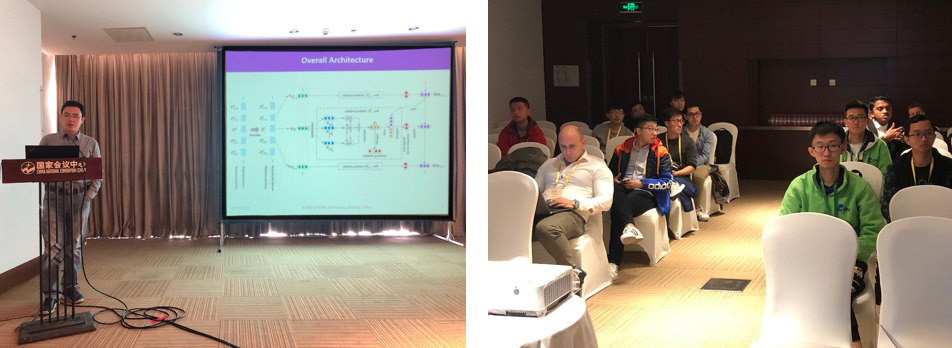
SENTIRE'18 (ICDM 2018, November 17th, Singapore)
PROGRAM
08:00-08:20 Welcoming and introduction (E Cambria)
08:20-09:20 Keynote on Target Sentiment Analysis (L Bing)
09:20-09:40 Stock Market Prediction Analysis by Incorporating Social and News Opinion (Z Wang)
09:40-10:00 Semi-Supervised Psychometric Scoring of Document Collections (B Suyunu)
☕ COFFEE BREAK
10:20-10:40 Spatio-Temporal Trend Analysis of the Brazilian Elections based on Twitter Data (B Garcia)
10:40-11:00 Overlapping Toxic Sentiment Classification using Deep Neural Architectures (HH Saeed)
11:00-11:20 Sentiment Prediction in Social Networks (S Jin)
11:20-11:40 Investigating Timing and Impact of News on the Stock Market (S Merello)
11:40-12:00 Concluding remarks (S Poria)
SPEAKER
Dr. Lidong Bing is a Staff Algorithm Engineer at R&D Center Singapore, Alibaba DAMO Academy. Prior to joining Alibaba, he was a Senior Researcher at Tencent AI Lab. Dr. Bing received his PhD degree from The Chinese University of Hong Kong and was a Postdoc Research Fellow in Carnegie Mellon University. His research interests include Sentiment Analysis, Text Generation/Summarization, Information Extraction, Knowledge Base, etc. Dr. Bing has published about 60 papers on top-tier conferences and journals. Dr. Bing served as SPC or PC for major AI and NLP conferences, such as ACL, EMNLP, AAAI, SIGIR, etc.
KEYNOTE
With the development of AI techniques, Sentiment Analysis becomes more and more important in different application scenarios, such as dialogue, text generation, review mining, etc. Target Sentiment Analysis is to analyze the sentiment on the mentioned targets in sentences. In this talk, I will introduce a line of research works on Target Sentiment Analysis: (1) RAM and TNet are two frameworks for Target Sentiment Prediction. RAM proposed a mechanism to pay multiple attentions over an input sentence, and non-linearly combine the attended information to handle some difficult cases. TNet is the first framework that applies CNN for feature extraction in this task and beats the RNN-based methods. Its state transformation strategy, accompanied by a context preserving mechanism, enables the CNN-based model to apply the target information. (2) For the task of Target Extraction, we proposed the HAST framework which can explore the prediction history information and the existence of opinion indicators for extracting more precise targets. Moreover, in our recent work, we proposed a unified solution of Target Extraction and Target Sentiment Prediction, and achieved consistent improvements over existing methods. (3) I will also introduce our work for learning domain-sensitive and sentiment-aware embeddings that simultaneously capture the information of sentiment semantics and domain sensitivity of individual words.
ORGANIZERS
• Erik Cambria, Nanyang Technological University (Singapore)
• Bing Liu, University of Illinois at Chicago (USA)
• Amir Hussain, University of Stirling (UK)
• Soujanya Poria, Nanyang Technological University (Singapore)
• Yongzheng Zhang, LinkedIn Inc. (USA)
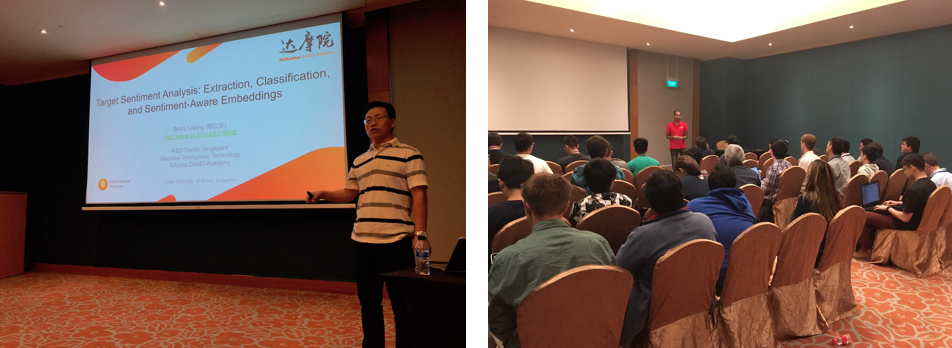
SENTIRE'17 (ICDM 2017, November 18th, New Orleans)
PROGRAM
08:30-08:45 Welcoming and introduction (E Cambria)
08:45-10:00 Keynote on the Role of Valence in Public Health Surveillance and Response (S Parthasarathy)
☕ COFFEE BREAK
10:15-10:40 Dataset Construction via Attention for Aspect Term Extraction with Distant Supervision (A Giannakopoulos)
10:45-11:10 Estimating Personality from Social Media Posts (D Skillicorn)
11:15-11:40 Learning-based Method with Valence Shifters for Sentiment Analysis (JM Loh)
🍝 LUNCH BREAK
13:00-13:25 Twitter Stance Detection - A Subjectivity and Sentiment Polarity Inspired Two-Phase Approach (K Dey)
13:30-13:55 Sentiment extraction from consumer-generated noisy short texts (H Meisheri)
14:00-14:25 Phonetics-Based Microtext Normalization for Twitter Sentiment Analysis (I Chaturvedi)
14:30-14:55 A Bootstrap Method for Automatic Rule Acquisition on Emotion Cause Extraction (S Yada)
☕ COFFEE BREAK
15:15-15:40 Analyzing users’ sentiment towards popular consumer industries and brands (GN Hu)
15:45-16:10 Analyzing Informal Caregiving Expression in Social Media (R Al-Bahrani)
16:15-16:40 Extracting User-Reported Mobile Application Defects from Online Reviews (Y Wang)
16:45-17:10 Let’s Chat about Brexit! A Politically-Sensitive Dialog System based on Twitter data (A Khatua)
17:10-17:30 Concluding remarks (E Cambria)
SPEAKER
Srinivasan Parthasarathy is a Professor of Computer Science and Engineering and the director of the data mining research laboratory at Ohio State. His research interests span databases, data mining and high performance computing. He is among a handful of researchers nationwide to have won both the Department of Energy and National Science Foundation Career awards. He and his students have won multiple best paper awards or "best of" nominations from leading forums in the field including: SIAM Data Mining, ACM SIGKDD, VLDB, ISMB, WWW, ICDM, and ACM Bioinformatics. He chairs the SIAM data mining conference steering committee and serves on the action board of ACM TKDD and ACM DMKD, leading journals in the field. Since 2012 he also helped lead the creation of OSU's first-of-a-kind nationwide (US) undergraduate major in data analytics and serves as one of its founding directors.
KEYNOTE
Public health response to mental and behavioral issues, epidemics and disasters depend on large-scale, informed and skills driven human efforts. Increasingly, social-media data and the information they yield, can play a key role in predicting, understanding and responding to mental and behavioral health issues, epidemics and disasters, but require technological advances to glean insight from the hidden patterns it contains to improve situational awareness impacting health response activities. Specifically, in this talk I will focus on the role of valence and pragmatics in two such contexts. First, I will discuss a domain-guided computational model to infer a model of trust among users within a social network during emergent situations, and the role of affective valence on the underlying model. Evaluations on real-world events suggest that incorporating valence is a key factor to realizing a stable model. Second, I will discuss an observational study we conducted to examine if one can identify relevant signals from social media exchanges to detect symptomatic cues of clinical depression and the role played by valence and emotional signals. Our findings corroborate well with offline studies in clinical psychology and social sciences.
ORGANIZERS
• Erik Cambria, Nanyang Technological University (Singapore)
• Bing Liu, University of Illinois at Chicago (USA)
• Amir Hussain, University of Stirling (UK)
• Yongzheng Zhang, LinkedIn Inc. (USA)
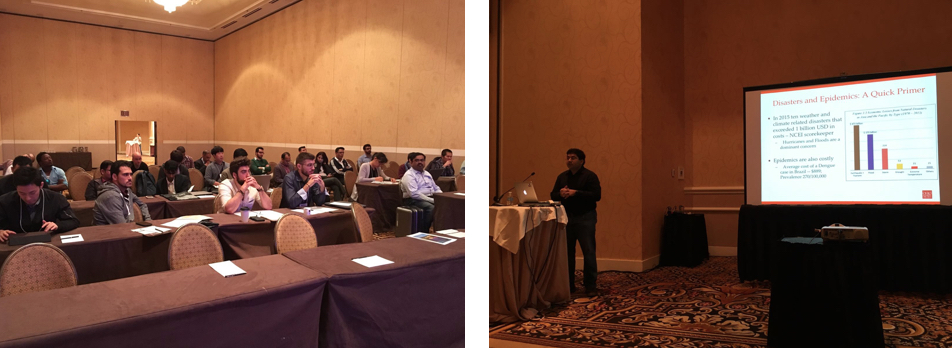
SENTIRE'16 (ICDM 2016, December 12th, Barcelona)
PROGRAM
09:30-09:40 Welcoming and introduction (E Cambria)
09:40-10:30 Keynote on harnessing reviews to build richer models of opinions (J McAuley)
☕ COFFEE BREAK
11:00-11:25 Scalable and Real-time Sentiment Analysis of Twitter Data (M Karanasou)
11:30-11:55 Mining the Opinionated Web: Classification and Detection of Aspect Contexts for Aspect Based Sentiment Analysis (O Araque)
12:00-12:25 Seasonal Fluctuations in Collective Mood Revealed by Wikipedia Searches and Twitter Posts (N Cristianini)
12:30-12:55 SmartVideoRanking: Video Search by Mining Emotions from Time-Synchronized Comments (K Tsukuda)
🍝 LUNCH BREAK
14:30-14:50 Research On Sentiment Analysis: The First Decade (O Ahlgren)
14:55-15:15 Bayesian Deep Convolution Belief Networks for Subjectivity Detection (I Chaturvedi)
15:20-15:40 Multi-Sentiment Modeling with Scalable Systematic Labeled Data Generation via Word2Vec Clustering (D Mayank)
15:45-16:05 Sentiment Lexica from Paired Comparisons (C Dalitz)
☕ COFFEE BREAK
16:30-16:50 Lexicon Knowledge Extraction with Sentiment Polarity Computation (ZX Wang)
16:55-17:15 The Truth and Nothing but the Truth: Multimodal Analysis for Deception Detection (M Jaiswal)
17:20-17:40 Modeling Satire in English Text for Automatic Detection (A Reganti)
17:45-18:05 What Drives Consumer Choices? Mining Aspects and Opinions on Large Scale Review Data using Distributed Representation of Words (L Petzold)
18:05-18:10 Concluding remarks (E Cambria)
SPEAKER
Dr. McAuley has been an Assistant Professor in the Computer Science Department at the University of California, San Diego since 2014. Previously, he was a postdoctoral scholar at Stanford University after receiving his PhD from the Australian National University in 2011. His research is concerned with developing predictive models of human behavior using large volumes of online activity data.
KEYNOTE
Online reviews are often our first port of call when considering products and purchases online. Yet navigating huge volumes of reviews (many of which we might disagree with) is laborious, especially when we are interested in some niche aspect of a product. This suggests a need to build models that are capable of capturing the complex and idiosyncratic semantics of reviews, in order to build richer and more personalized recommender systems. In this talk I'll discuss three such directions: First, how can reviews be harnessed to better understand the dimensions (or facets) of people's opinions? Second, how can reviews be used to answer targeted questions, that may be subjective or require personalized responses? And third, how can reviews themselves be synthesized, so as to predict what a reviewer would say, even for products they haven't seen yet?
ORGANIZERS
• Erik Cambria, Nanyang Technological University (Singapore)
• Bing Liu, University of Illinois at Chicago (USA)
• Amir Hussain, University of Stirling (UK)
• Yongzheng Zhang, LinkedIn Inc. (USA)
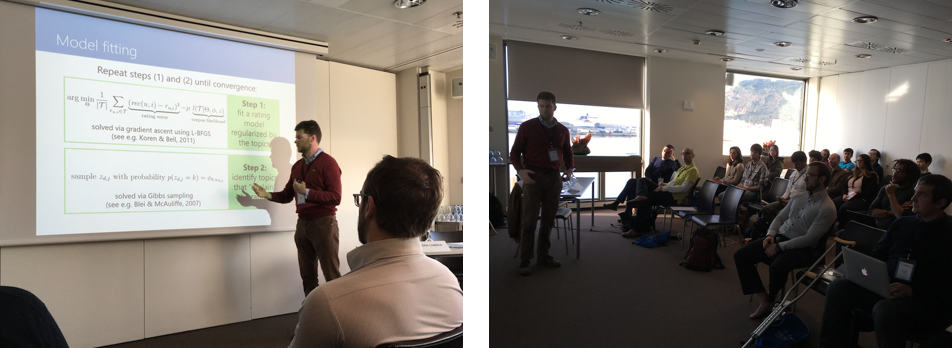
SENTIRE'15 (ICDM 2015, November 14th, Atlantic City)
PROGRAM
14:00-14:05 Welcoming and introduction (E Cambria)
14:05-14:45 Invited Talk (CT Lu)
14:45-15:05 An Ensemble Sentiment Classification System of Twitter Data for Airline Services Analysis (Y Wan)
15:05-15:25 Production Estimation for Shale Wells with Sentiment-based Features from Geology Reports (B Tong)
15:25-15:45 OntoSeg: a Novel Approach to Text Segmentation using Ontological Similarity (M Bayomi)
☕ COFFEE BREAK
16:00-16:20 Improving Out-of-domain Sentiment Polarity classification using Argumentation (L Carstens)
16:20-16:40 Exploiting the Focus of the Document for Enhanced Entities’ Sentiment Relevance Detection (Z Ben-Ami)
16:40-17:00 Towards Domain-Independent Opinion Target Extraction (A Wawer)
17:00-17:20 Lexical Resource for Medical Events: A Polarity Based Approach (A Mondal)
17:20-17:40 Sentiment Polarity Classification using Structural Features (D Ansari)
17:40-17:45 Concluding remarks (E Cambria)
SPEAKER
Chang-Tien Lu is an Associate Professor of the Department of Computer Science and Associate Director of the Discovery Analytics Center at Virginia Tech. He served as Program Co-Chair of the 18th IEEE International Conference on Tools with Artificial Intelligence in 2006 and as General Co-Chair of the 20th IEEE International Conference on Tools with Artificial Intelligence in 2008 and the 17th ACM SIGSPATIAL International Conference on Advances in Geographic Information Systems in 2009. He also served as Secretary (2008-2011) and Vice Chair (2011-2014) of the ACM Special Interest Group on Spatial Information (ACM SIGSPATIAL). Dr. Lu's research work focuses on emerging requirements for analyzing, retrieving, and visualizing massive data. His ongoing projects range from explorations of fundamental access issues to practical applications that deal with data analysis and knowledge discovery tasks. His research has been sponsored by the NSF, NIH, DoD, IARPA, VDOT, and DCDOT. He received his Ph.D. in Computer Science from the University of Minnesota at Twin Cities.
KEYNOTE
Social media has become a popular data source as a surrogate for monitoring and detecting events. Analyzing social media (e.g., tweets) to reveal event information requires sophisticated techniques. Tweets are written in unstructured language and often contain typos, non-standard acronyms, and spam. In addition to the textual content, Twitter data form a heterogeneous information network where users, tweets, and hashtags have mutual relationships. These features pose technical challenges for designing event detection and forecasting methods. In this talk, I will present the design and implementation of EMBERS, a fully automated 24x7 forecasting system for significant societal events using open source data including tweets, blog posts, and news articles. I will describe the system architecture of EMBERS, individual models that leverage specific data sources, and a fusion engine that supports trading off specific evaluation criteria. I will also demonstrate the superiority of EMBERS over base rate methods and its capability to forecast significant societal happenings.
ORGANIZERS
• Erik Cambria, Nanyang Technological University (Singapore)
• Bing Liu, University of Illinois at Chicago (USA)
• Yunqing Xia, Microsoft Research Asia (China)
• Yongzheng Zhang, LinkedIn Inc. (USA)
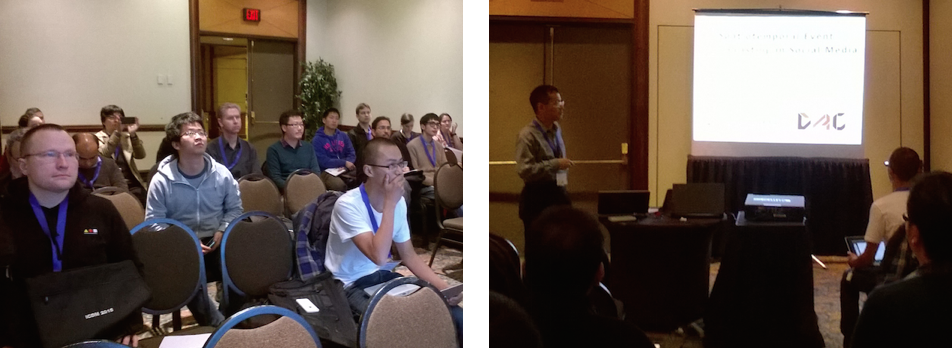
SENTIRE'14 (ICDM 2014, December 14th, Shenzhen)
PROGRAM
08:30-08:45 Welcoming and introduction (E Cambria)
08:45-09:30 From Big Data to Smart Nation: The Social Media Mining Perspective (EP Lim)
09:30-10:00 A Semi-supervised Self-Adaptive Classifier over Opinionated Streams (M Zimmermann)
☕ COFFEE BREAK
10:30-11:00 Social Preference Ontologies for Enriching User and Item Data in Recommendation Systems (C Krauss)
11:00-11:30 Joint Propagation and Refinement for Mining Opinion Words and Targets (QY Zhao)
11:30-12:00 Semi-Supervised Method for Multi-Category Emotion Recognition in Tweets (V Sintsova)
12:00-12:30 A Hybrid Approach for Emotion Detection in Support of Affective Interaction (S Gievska)
🍝 LUNCH BREAK
14:00-14:30 A Localization Toolkit for SenticNet (XY Li)
14:30-15:00 Towards Summarizing Popular Information from Massive Tourism Blogs (H Yuan)
15:00-15:30 Emotion Recognition from Text Based on Automatically Generated Rules (W El-Hajj)
☕ COFFEE BREAK
16:00-16:30 Commonsense Knowledge as the Glue in a Hybrid Model of Computational Creativity (A Gómez)
16:30-17:00 Cyberbullying Detection using Time Series Modeling (N Potha)
SPEAKER
Ee-Peng Lim is a Professor at the School of Information Systems of Singapore Management University (SMU). He received Ph.D. from the University of Minnesota, Minneapolis in 1994 and B.Sc. in Computer Science from National University of Singapore. His research interests include social network and web mining, information integration, and digital libraries. He is currently an Associate Editor of the ACM Transactions on Information Systems (TOIS), Information Processing and Management (IPM), Social Network Analysis and Mining, Journal of Web Engineering (JWE), IEEE Intelligent Systems, International Journal of Digital Libraries (IJDL) and International Journal of Data Warehousing and Mining (IJDWM). He was a member of the ACM Publications Board until December 2012. He serves on the Steering Committee of the International Conference on Asian Digital Libraries (ICADL), Pacific Asia Conference on Knowledge Discovery and Data Mining (PAKDD), and International Conference on Social Informatics (SocInfo).
KEYNOTE
Social media mining research has been extremely vibrant in the last few years as much social media data are available to researchers for data science works. The relevant research topics covered span from topic trend and event analysis to social community and event discovery. In all these topics, sentiment and emotion expressed in social media are important components of the modeling and empirical research. In this talk, we will give an overview of the use of sentiment and emotion analyses to extract insights about users, communities, businesses, and events. Such insights can benefit many social and business applications including recommendations, customer relationship management, and policy making. We will also showcase a realtime social media analytics system that incorporates sentiment and emotion analysis.
ORGANIZERS
• Erik Cambria, Nanyang Technological University (Singapore)
• Bing Liu, University of Illinois at Chicago (USA)
• Yunqing Xia, Tsinghua University (China)
• Yongzheng Zhang, LinkedIn Inc. (USA)
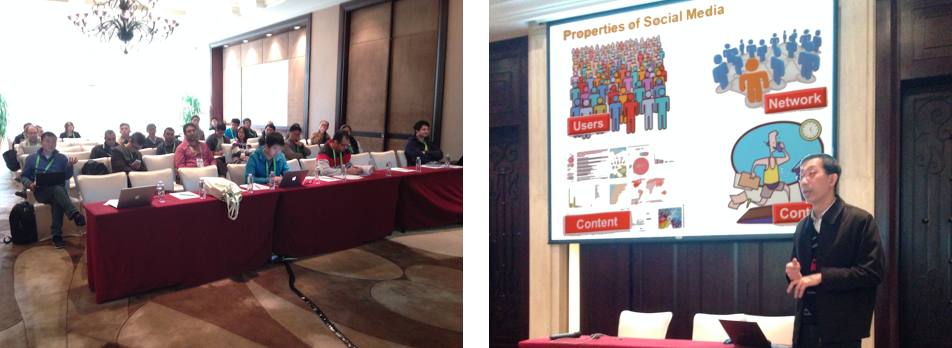
SENTIRE'13 (ICDM 2013, December 7th, Dallas)
PROGRAM
08:30-08:45 Welcoming and introduction (E Cambria)
08:45-09:30 Keynote on a cross-corpus study of subjectivity identification using unsupervised learning (Y Liu)
09:30-10:00 Multi-class sentiment analysis with clustering and score representation (M Farhadloo)
☕ COFFEE BREAK
10:30-11:00 Interest analysis using semantic PageRank and social interaction content (CC Huang)
11:00-11:30 Learning the roles of directional expressions and domain concepts in financial news analysis (P Takala)
11:30-12:00 Robust language learning via efficient budgeted online algorithms (G Castellucci)
🍝 LUNCH BREAK
13:30-13:45 Possible usage of sentiment analysis for calculating vectors of felific calculus (R Rzepka)
13:45-14:00 Interpreting or describing? Measuring verb abstraction (A Wawer)
14:15-14:30 Sentiment analysis in news articles using sentic computing (P Raina)
14:30-14:45 Enhancing sentiment classification performance using bi-tagged phrases (B Agarwal)
14:45-15:00 A framework of review analysis for enhancement of business decision making (A Qazi)
☕ COFFEE BREAK
15:30-16:00 Joint and pipeline probabilistic models for fine-grained sentiment analysis: Extracting aspects, subjective phrases and their relations (R Klinger)
16:00-16:30 Dynamic construction of dictionaries for sentiment classification (H Ameur)
16:30-17:00 Subjective Bayes method for word semantic similarity measurement (JH Wang)
17:00-17:30 Pattern enhanced topic models for information filtering (Y Xu)
17:30-18:00 Concluding remarks (E Cambria)
SPEAKER
Yang Liu is currently an Associate Professor in the Computer Science
Department at the University of Texas at Dallas (UTD). She received her
B.S. and M.S degree from Tsinghua University, and Ph.D from Purdue
University. She was a researcher at the International Computer
Science Institute (ICSI) at Berkeley before she joined UTD in
2005. Dr. Liu's research interest is in speech and natural language
processing. She has published over 100 papers in this field. Dr. Liu
received the NSF CAREER award in 2009 and the Air Force Young Investigator
Program (YIP) award in 2010. She is currently an Associate editor of IEEE
Transactions on Audio, Speech, and Language Processing; ACM Transactions
on Asian Language Information Processing; and Speech Communication.
KEYNOTE
Sentiment/opinion analysis has received increasing attention in the past
decade. The dominant approach has been based on supervised machine
learning methods. However, these methods require a reasonable amount of
annotated training data and often suffer from mismatched training and
testing conditions. In this talk, the keynote speaker will present a study using
unsupervised/semi-supervised generative learning methods for subjectivity
detection across different domains. An initial training set
using simple lexicon information is created, and then two iterative learning
methods with a base naive Bayes classifier to learn from unannotated data are evaluated.
The first method is self-training, which adds instances with high
confidence into the training set in each iteration. The second is a
calibrated EM (expectation-maximization) method where we calibrate the
posterior probabilities from EM such that the class distribution is
similar to that in the real data. Both approaches are evaluated on three
different domains: movie data, news, and meeting dialogues. The keynote speaker will
discuss various findings about the impacting factors for the model
behaviors and show the inherent differences across domains.
ORGANIZERS
• Erik Cambria, National University of Singapore (Singapore)
• Bing Liu, University of Illinois at Chicago (USA)
• Yunqing Xia, Tsinghua University (China)
• Ping Chen, University of Houston-Downtown (USA)
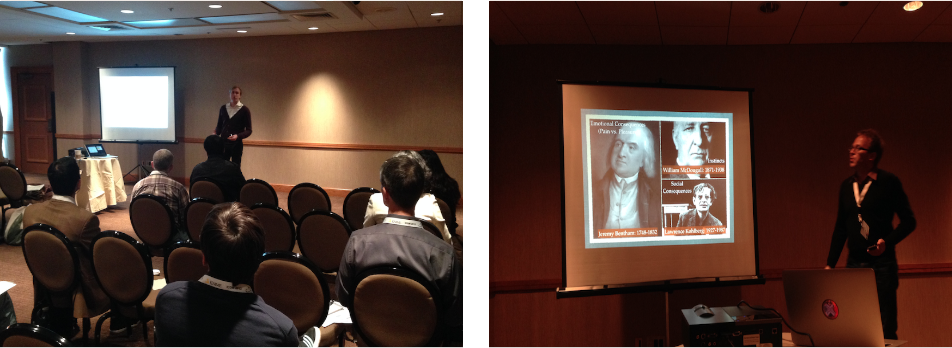
SENTIRE'12 (ICDM 2012, December 10th, Brussels)
PROGRAM
09:00-09:10 Welcoming and introduction (E Cambria)
09:10-10:00 Keynote on multimodal sentiment analysis (R Mihalcea)
☕ COFFEE BREAK
10:30-11:00 How much supervision? Corpus-based lexeme sentiment estimation (A Wawer)
11:00-11:30 Domain adaptation using domain similarity- and domain complexity-based instance selection for cross-domain sentiment analysis (R Remus)
11:30-12:00 Sentiment polarity classification using statistical data compression models (D Ziegelmayer)
🍝 LUNCH BREAK
13:30-14:00 Representing and resolving negation for sentiment analysis (E Lapponi)
14:00-14:30 Fine-grained product features extraction and categorization in reviews opinion mining (S Huang)
14:30-15:00 Subjectivity-based features for sentiment classification: A study on two lexicons (R Dehkharghani)
15:00-15:30 Learning domain-specific polarity lexicons (G Demiroz)
☕ COFFEE BREAK
16:00-16:30 A regularized recommendation algorithm with probabilistic sentiment-ratings (F Peleja)
16:30-17:00 Enriching SenticNet polarity scores through semi-supervised fuzzy clustering (S Poria)
17:00-17:30 Full spectrum opinion mining: Integrating domain, syntactic and lexical knowledge (D Olsher)
17:30-18:00 Concluding remarks (E Cambria)
SPEAKER
Rada Mihalcea is an Associate Professor in the Department of Computer Science and Engineering at the University of North Texas. Her research interests are in computational linguistics, with a focus on lexical semantics, graph-based algorithms for natural language processing, and multilingual natural language processing. She serves or has served on the editorial boards of the Journals of Computational Linguistics, Language Resources and Evaluations, Natural Language Engineering, Research in Language in Computation, IEEE Transactions on Affective Computing, and Transactions of the Association for Computational Linguistics. She was a program co-chair for the Conference of the Association for Computational Linguistics (2011), and the Conference on Empirical Methods in Natural Language Processing (2009). She is the recipient of a National Science Foundation CAREER award (2008) and a Presidential Early Career Award for Scientists and Engineers (2009).
KEYNOTE
With more than 10,000 new videos posted online every day on social websites such as YouTube and Facebook, the internet is becoming an almost infinite source of information. One crucial challenge for the coming decade is to be able to harvest relevant information from this constant flow of multi-modal data. In this talk, the keynote speaker will introduce the task of multi-modal sentiment analysis, and present a method that integrates linguistic, audio, and visual features for the purpose of identifying sentiment in online videos. The invited speaker will first describe a novel dataset consisting of videos collected from the social media website YouTube and annotated for sentiment polarity. She will then show, through comparative experiments, that the joint use of visual, audio, and textual features greatly improves over the use of only one modality at a time. Finally, by running evaluations on datasets in English and Spanish, the keynote speaker will show that the method is portable and works equally well when applied to different languages.
ORGANIZERS
• Erik Cambria, National University of Singapore (Singapore)
• Bing Liu, University of Illinois at Chicago (USA)
• Yunqing Xia, Tsinghua University (China)
• Catherine Havasi, MIT Media Laboratory (USA)
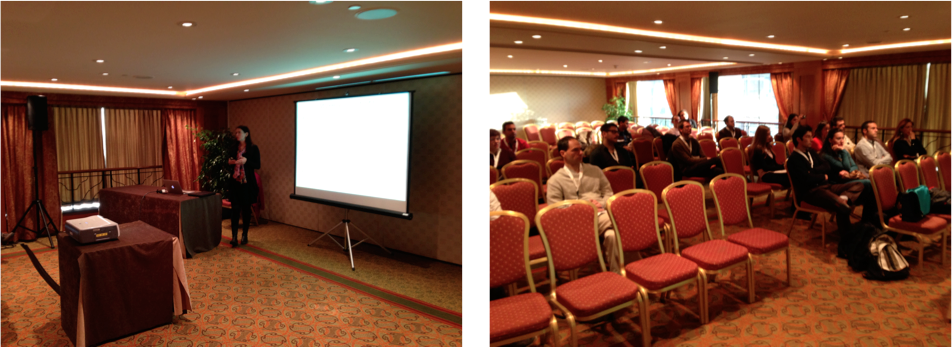
SENTIRE'11 (ICDM 2011, December 11th, Vancouver)
PROGRAM
08:30-08:40 Welcoming and introduction (E Cambria)
08:40-09:30 Keynote on discovery and challenges of sentiment analysis: A (B Liu)
09:35-10:00 STARLET: Multi-document summarization of service and product reviews with balanced rating distributions (G Di Fabbrizio)
☕ COFFEE BREAK
10:30-10:55 Multilingual sentiment analysis using latent semantic indexing and machine learning (P Kegelmeyer)
11:00-11:25 Deriving insights from national happiness indices (D Archambault)
11:30-11:55 Multi-aspect sentiment analysis with topic models (M Ott)
12:00-12:30 AQA: Aspect-based opinion question answering (S Moghaddam)
🍝 LUNCH BREAK
14:00-14:15 Improving sentiment classification using feature highlighting and feature bagging (L Dai)
14:20-14:35 Machine reading for notion-based sentiment mining (R Hobeica)
14:40-14:55 Mining opinion attributes from texts using multiple kernel learning (A Wawer)
15:00-15:15 Longitudinal sales responses with online reviews (WY Liu)
15:20-15:35 Fine-grained opinion mining using conditional random fields (S Shariaty)
15:40-16:00 Discourse structure and sentiment (L Polanyi)
☕ COFFEE BREAK
16:30-16:55 Detecting general opinions from customer surveys (E Stepanov)
17:00-17:25 SES: Sentiment elicitation system for social media data (YS Xie)
17:30-18:00 Concluding remarks (E Cambria)
SPEAKER
Bing Liu is a professor of Computer Science at University of Illinois at Chicago (UIC). He received his PhD in Artificial Intelligence from the University of Edinburgh. Before joining UIC, he was with the National University of Singapore. His current research interests include opinion mining and sentiment analysis, Web mining, and data mining. He has published extensively in leading conferences and journals in these fields. He has also written a textbook titled “Web Data Mining: Exploring Hyperlinks, Contents and Usage Data” published by Springer. The second edition of the book came out in July 2011. On professional services, Liu has served as program chairs of ACM SIGKDD International Conference on Knowledge Discovery and Data Mining (KDD), IEEE International Conference on Data Mining (ICDM), ACM Conference on Web Search and Data Mining (WSDM), SIAM Conference on Data Mining (SDM), ACM Conference on Information and Knowledge Management (CIKM), and Pacific Asia Conference on Data Mining (PAKDD). Additionally, he has also served as associate editors of IEEE Transactions on Knowledge and Data Engineering (TKDE), Journal of Data Mining and Knowledge Discovery (DMKD), and SIGKDD Explorations, and is on the editorial boards of several other journals.
KEYNOTE
Sentiment analysis and opinion mining is the computational study of people’s opinions, evaluations, appraisals, attitudes, and emotions toward entities, issues, events, topics and their attributes. It has become a very active research area in natural language processing (NLP) and text mining due to many challenging research problems and a wide arrange of applications. The research has also spread from computer science to management science and social sciences. Although a large number of papers have been published, the pace of the progress has not been very fast due to the difficulty of natural language understanding. Many (if not most) existing papers do not make a lot of practical impact. One of the bottlenecks to the progress is the lack of effective mining algorithms that can discover complex expressions and domain commonsense knowledge which are essential for determining sentiment orientations and for recognizing targets of opinions. In this talk, Professor Bing Liu will first introduce the sentiment analysis and opinion mining problem, and then discuss several sub-problems which need novel data mining algorithms that can work collaboratively with NLP techniques for their solution.
ORGANIZERS
• Erik Cambria, National University of Singapore (Singapore)
• Yangqiu Song, Microsoft Research Asia (China)
• Catherine Havasi, MIT Media Laboratory (USA)
• Amir Hussain, University of Stirling (UK)
follow SenticNet on


